
Table of Contents
- What Strata Exterior Maintenance Includes
- Strata Maintenance Responsibilities: Who Does What
- Strata Gutter Maintenance: Preventing Water Damage
- Strata Exterior Cleaning: Maintenance Checklist and Schedule
- Strata Exterior Cleaning Methods and Best Practices
- Preventive Maintenance and Early Warning Signs
- Maintenance Budgeting and Planning
- Frequently Asked Questions
Last Updated: October 14, 2026
What Strata Exterior Maintenance Includes
Strata exterior maintenance covers all shared surfaces and structures forming the building envelope and common areas of your multi-unit residential property, from the roof to ground-level driveways. Understanding what falls under this category is crucial for strata managers, lot owners, and body corporate members responsible for budgeting and planning maintenance cycles.
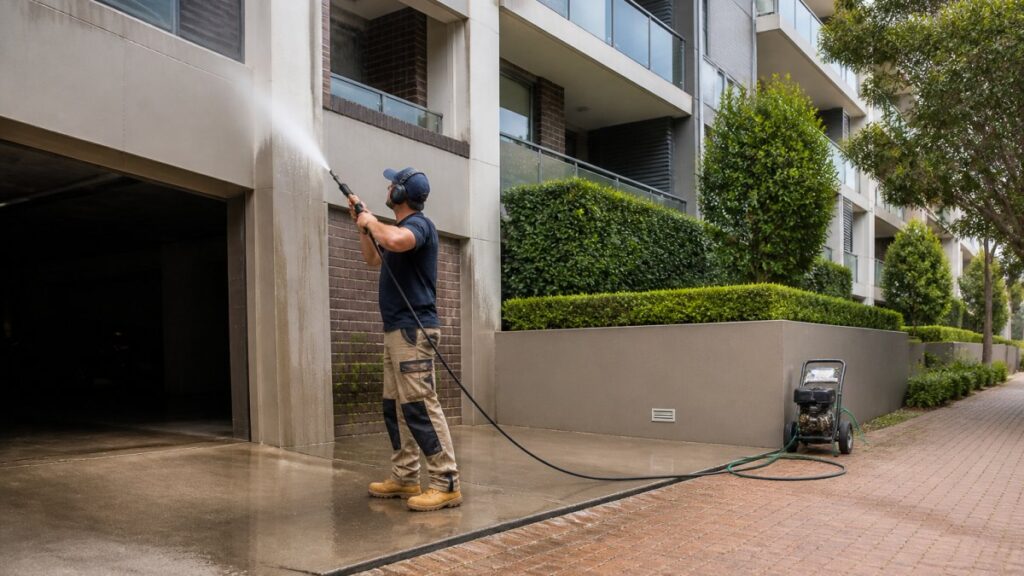
The scope typically covers building facades, roofing systems, drainage infrastructure, windows and doors, balconies, landscaped areas, and shared pathways, each requiring different maintenance schedules and techniques. At Sydney Pressure Washing Service, we work with strata managers across the region using appropriate methods, from high-pressure washing on concrete to soft washing on delicate cladding.
Building Exterior and Cladding
Your building’s exterior cladding, whether brick, rendered concrete, vinyl, or composite, is the first line of defence against weather and pollutants. Over time it accumulates dirt, algae, mould, and weathering stains that compromise appearance and longevity.
Cladding maintenance is more than cosmetic. Mould growth indicates moisture issues that may penetrate deeper into the structure, and dirt traps moisture against surfaces, accelerating degradation. Professional exterior cleaning removes these contaminants safely: soft washing on delicate materials prevents damage, whilst high-pressure techniques suit strong concrete or brick.
Roofs, Gutters, and Downpipes
Roof maintenance is among the most critical strata exterior maintenance tasks because water ingress leads to costly structural damage. When gutters and downpipes clog with leaves, debris, or moss, water backs up, pools on the roof, and eventually penetrates interior spaces, compounding rapidly and becoming expensive to repair.
Gutter systems require inspection at least twice annually, particularly after autumn leaf fall and before winter rains, and downpipes must remain clear and aligned to direct water away from foundations.
Windows, Doors, and Flyscreens
Windows and doors are vulnerable points where water can penetrate if seals deteriorate or frames are compromised by dirt. Frames and sills collect debris, bird droppings, and mould that damage weatherproofing seals, whilst flyscreens trap dust and pollen that restrict airflow and harbour bacteria.
Regular cleaning of frames, sills, and seals, combined with inspection for cracks or separation, prevents water ingress, maintains thermal efficiency, and avoids expensive water damage claims.
Balconies, Courtyards, and Boundary Areas
Balconies are exposed to weather on all sides and often feature mixed surfaces: timber railings, concrete or tile flooring, metal fixtures.
Boundary areas, fences, hedges, and demarcation lines require regular attention to maintain perimeter definition and security, with seasonal landscaping to prevent overgrowth that obscures sightlines or damages adjacent surfaces. These spaces influence first impressions and the overall appearance of the strata scheme.
Walkways, Driveways, and Common Flooring
Concrete driveways, walkways, and common-area flooring are high-traffic surfaces exposed to vehicle fluids, weather staining, and organic growth. Oil stains, tyre marks, and algae create slip-and-fall hazards, particularly when wet, and stained common areas suggest poor maintenance throughout the scheme.
Regular cleaning removes contaminants, restores slip resistance, and extends material life. Pressure washing suits strong concrete, whilst softer surfaces need gentler techniques, and proper drainage prevents pooling that accelerates deterioration and staining.
Strata Maintenance Responsibilities: Who Does What
Clear responsibility allocation is essential for effective strata exterior maintenance. Confusion over who handles specific tasks leads to neglected maintenance, disputes between the body corporate and lot owners, and costly emergency repairs that regular upkeep could have prevented.
Owners Corporation and Body Corporate Duties
The owners corporation (or body corporate, depending on your state’s terminology) holds primary responsibility for maintaining common property: the roof, external walls, gutters, downpipes, common driveways, shared pathways, and communal landscaping.
The body corporate also arranges inspections, engages contractors, ensures work meets standards, and maintains adequate insurance for the building structure and common property. In practice, often through a strata manager, it develops a maintenance plan, allocates budget, and coordinates exterior maintenance tasks.
Lot Owner Responsibilities
Individual lot owners typically maintain the interior of their units and any exclusive-use areas, such as private balconies or courtyards allocated solely to that lot.
Lot owners must maintain exclusive-use areas to prevent damage affecting common property; poor balcony waterproofing, for example, can cause water ingress into the structure below. Review your scheme’s by-laws and, if disputes arise, consult your state’s strata legislation or seek legal advice.
Strata Gutter Maintenance: Preventing Water Damage
Gutter maintenance is perhaps the most overlooked strata exterior maintenance task, yet among the most critical for preventing expensive water damage. Blocked gutters cause water to back up, pool on the roof, penetrate the building envelope, and cause structural damage that can take months or years to manifest.
Inspection and Cleaning Frequency
Professional gutter inspection should occur at least twice yearly, ideally in autumn after leaf fall and in spring before heavy rain, and more often with significant tree coverage. Check for debris accumulation, moss or algae growth, sagging sections, and separation at joints; early detection prevents emergencies and allows planned, cost-effective repairs.
Cleaning frequency depends on the environment: properties surrounded by deciduous trees need more frequent cleaning than those in open areas, and coastal properties accumulate salt residue requiring different approaches. Professional cleaners can assess your situation and recommend intervals.
Signs of Damage and Deterioration
Watch for water stains on external walls below gutters, which indicate overflow or leakage. Moss or algae growth signals moisture retention that accelerates corrosion, sagging suggests debris weight or structural failure, and rust stains indicate the system may fail soon.
Interior signs include water stains on ceilings or walls, damp patches in roof cavities, or mould in upper-floor interiors, suggesting water has already penetrated the building envelope. Addressing gutter problems before interior damage occurs is far more cost-effective than remediation after water ingress.
Strata Exterior Cleaning: Maintenance Checklist and Schedule
Systematic, scheduled maintenance prevents problems from becoming expensive emergencies. A comprehensive checklist ensures nothing is overlooked, and a defined schedule helps the body corporate budget and communicate plans to residents.
Monthly and Seasonal Tasks
Monthly inspections should check for debris accumulation, visible damage, or water leakage, with additional inspections after severe weather.
Spring and autumn are ideal for thorough exterior cleaning: spring removes winter accumulation and prepares the building for summer, whilst autumn clears leaves and prepares drainage for winter rains. Landscaping follows seasonal patterns, with pruning in winter, mulching in spring, and pest management through growing seasons.
Annual and Long-Term Maintenance
Annual maintenance should include professional pressure or soft washing of all exterior surfaces, depending on material and condition, roof inspection by qualified professionals, waterproofing assessment of seals around windows, doors, and penetrations, and deep cleaning of balcony and courtyard surfaces.
Long-term planning addresses component replacement cycles: roof membranes typically last 20-30 years, guttering 25-40 years depending on material and environment, and window and door seals degrade over time. Planning major works in advance lets the body corporate budget appropriately and avoid emergency expenditure.
Strata Exterior Cleaning Methods and Best Practices
The method chosen for strata exterior maintenance affects results, surface longevity, and environmental impact. Different surfaces require different approaches; the wrong technique can damage delicate materials or prove ineffective on strong ones.
Pressure Washing Versus Soft Washing
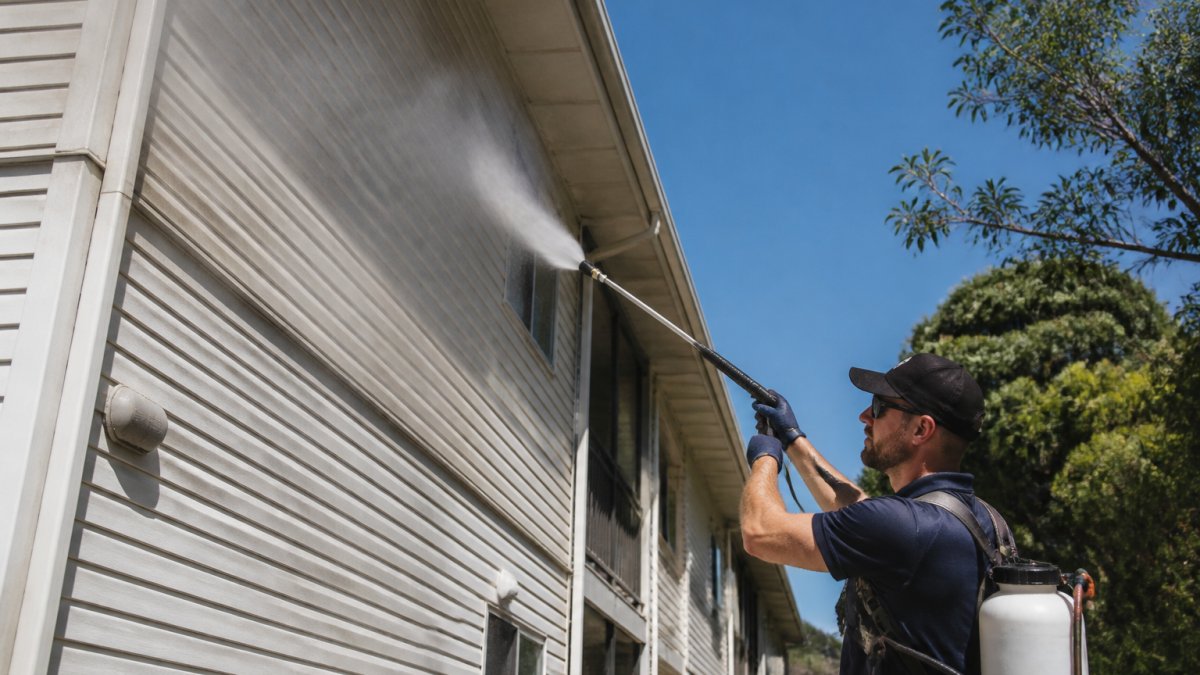
High-pressure washing uses water jets at 3,000+ PSI to remove dirt, algae, and staining, working excellently on concrete driveways, strong brick, and commercial-grade materials. However, it can permanently scar or strip delicate surfaces such as soft brick, rendered finishes, timber cladding, and composites.
Soft washing uses lower pressure with biodegradable solutions that chemically break down organic growth and staining. Ideal for delicate surfaces, painted finishes, and materials where appearance matters, it produces longer-lasting results because the solutions inhibit regrowth of algae and mould.
Protecting Surfaces and the Environment
Professional exterior cleaning should shield adjacent surfaces, landscaping, windows, and neighbouring properties from spray and cleaning solutions. Biodegradable solutions are essential for strata properties where runoff affects shared landscaping and stormwater systems, and environmental responsibility is a legal and ethical obligation for body corporates.
Proper technique prevents damage to delicate surfaces. Professionals understand how materials respond to different pressures and solutions, which surfaces need pre-treatment for stubborn staining, and which benefit from post-treatment sealers. This expertise prevents costly mistakes and extends surface life rather than accelerating deterioration.
Preventive Maintenance and Early Warning Signs
Preventive maintenance, addressing small issues before they become major problems, is the most cost-effective approach to strata exterior maintenance. Regular inspections identify emerging problems when they’re still manageable and inexpensive to address.
Common early warning signs include small water stains suggesting minor leaks, isolated algae or mould indicating moisture issues, hairline cracks in cladding or rendering, and rust stains suggesting corrosion.
Regular professional inspections catch problems invisible to untrained eyes, as structural engineers and building specialists know where issues typically develop.
Maintenance Budgeting and Planning
Effective strata exterior maintenance requires realistic budgeting and long-term planning.
Develop a 10-year maintenance plan identifying major works likely needed, such as roof replacement, external repainting, waterproofing renewal, and landscaping overhaul.
According to guidance from the Owners Corporations Institute, bodies corporate should maintain sinking funds or reserve funds sufficient to cover anticipated major works.
Regular professional assessments inform realistic planning by identifying components approaching end-of-life and helping prioritise works.
Effective strata exterior maintenance protects your building’s structure, maintains property values, and ensures resident safety.
Sydney Pressure Washing Service works with strata managers and body corporates to maintain building exteriors using appropriate techniques for each surface type. We understand the specific challenges of strata properties and help bodies corporate maintain consistent, professional appearance whilst protecting their buildings’ long-term integrity. Contact us for a free quote on your strata exterior maintenance needs.
Frequently Asked Questions
What is included in strata exterior maintenance?
Strata exterior maintenance covers the building’s outer surfaces and shared common areas. This includes the roof, gutters, downpipes, building cladding, windows, doors, flyscreens, balconies, courtyards, boundary fences, walkways, driveways, and shared flooring. The owners corporation is typically responsible for maintaining these elements to protect the building’s structural integrity and ensure consistent appearance across the scheme.
Who is responsible for strata maintenance responsibilities in my building?
The owners corporation or body corporate is responsible for maintaining common property, including the building exterior. Individual lot owners maintain their private interiors and lot-specific elements. However, responsibility boundaries vary by strata scheme and state legislation. Your strata scheme’s by-laws and maintenance plan should clarify which party pays for specific repairs. When disputes arise, the governing documents and local strata laws determine who bears the cost.
How often should strata gutter maintenance be performed?
Gutters and downpipes should be inspected at least twice yearly, typically in autumn and spring, to remove debris and check for damage. In areas with heavy leaf fall or coastal salt spray, quarterly inspections may be necessary. Regular cleaning prevents water ingress, which can lead to serious structural damage and costly repairs. Early detection of leaking windows, rust, or sagging sections allows preventive action before minor issues become expensive problems.
What is the difference between pressure washing and soft washing for strata exterior cleaning?
Pressure washing uses high-pressure water jets to remove stubborn stains, mould, and grime from hard surfaces like concrete driveways and tiles. Soft washing applies lower pressure with biodegradable cleaning solutions, making it safer for delicate surfaces such as wood siding, vinyl cladding, and roof tiles. Soft washing prevents surface damage and is more environmentally conscious. The choice depends on the surface type and level of contamination; many strata buildings benefit from both methods applied to different areas.
What are common early warning signs that strata exterior maintenance is needed?
Watch for black spots or green algae on roofs and cladding, indicating mould growth. Leaking windows or water stains on walls suggest waterproofing issues. Cracked or missing roof tiles, sagging gutters, and rust on metal components signal structural deterioration. Moss or slippery buildup on walkways and driveways poses safety hazards. Peeling paint or discoloured cladding indicates gradual deterioration. Regular inspections catch these signs early, allowing preventive maintenance that avoids expensive repairs and maintains property value.
How should strata levies be budgeted for exterior maintenance?
Strata levies should fund both routine maintenance and a reserve for major works like roof replacement or exterior repainting. A maintenance plan helps forecast costs over 5-10 years, allowing owners to budget predictably. Regular inspections identify deterioration early, reducing emergency repair costs. Preventive maintenance, such as gutter cleaning and soft washing, costs far less than addressing water damage or structural issues. Consult your strata manager about reserve fund adequacy and whether current levies cover planned maintenance schedules.
