
Table of Contents
- What Drives the Cost of Exterior House Cleaning
- Pressure Washing Price Per Square Metre vs Hourly Rates
- Soft Washing vs Pressure Washing Cost
- House Washing Preparation Tips to Avoid Extra Charges
- What a Professional Exterior House Clean Includes
- DIY vs Professional Cleaning: The Real Cost Comparison
- Licensing, Insurance and Surface Risks to Check
- Conclusion
- Frequently Asked Questions
Last Updated: September 10, 2026
What Drives the Cost of Exterior House Cleaning
The cost of exterior house cleaning depends on several variables: how big the property is, how many storeys, what surfaces need attention, and how much grime has built up.
At Sydney Pressure Washing Service, we quote jobs every week, and the same pattern holds: two homes on the same street can differ by hundreds of dollars based on access alone.
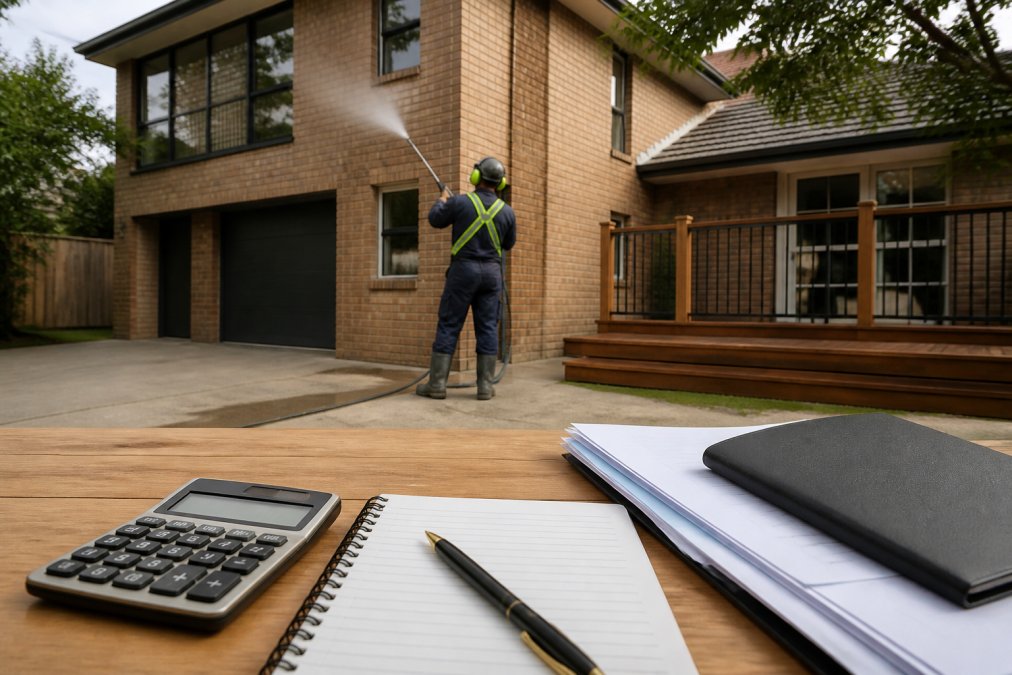
Below, we break down exactly what moves the number, so you can budget accurately and spot a fair quote when you see one.
Property Size and Storeys
Floor area is the starting point for any exterior house cleaning quote. A single-storey home with 150 square metres of exterior surface costs less to clean than a double-storey property of the same footprint, because height adds setup time, safety requirements and equipment.
Double-storey homes typically attract a premium over equivalent single-storey properties.
The reason is practical: working at height requires ladders, harnesses, and sometimes elevated platforms. Every storey adds time, and time is the biggest cost driver in this trade.
Surface Type and Condition
Not all surfaces clean the same way. Concrete driveways handle high-pressure water jetting well. Timber decking, painted render, and Colorbond roofs need a gentler approach, usually soft washing with low pressure and biodegradable detergents.
Surface condition matters just as much. A lightly soiled home might need one pass. A property with years of mould and mildew buildup, or heavy grime on north-facing walls, could need pre-treatment, dwell time, and a second application.
Ask your contractor whether they use a neutraliser after chemical cleaning. Detergents that kill mould can leave residue that affects plants and nearby surfaces if they’re not rinsed and neutralised properly.
Pressure Washing Price Per Square Metre vs Hourly Rates
Pressure washing price per square metre is the most common quoting method for exterior house washing, and it’s usually the fairest for both parties. Most contractors charge per square metre for standard surfaces, with the rate varying by surface type and access difficulty.
Hourly labour rates are also a common pricing method for a two-person crew. For smaller jobs, hourly pricing can work out cheaper. For large properties, square metre rates give you a fixed number before work starts.
| Quoting Method | Typical Rate | Best For | Watch Out For |
|---|---|---|---|
| Per square metre | $3-$8/m² | Large properties, predictable surfaces | Minimum call-out fees |
| Hourly labour rate | $80-$120/hr | Small jobs, complex access | Open-ended totals |
| Fixed price per job | Quote-based | Most residential work | Scope exclusions |
The table above shows why fixed pricing has become the default for residential exterior house cleaning. You know the total before anyone picks up a wand.
Soft Washing vs Pressure Washing Cost
Soft washing vs pressure washing cost is closer than most homeowners expect. Soft washing typically costs more than high-pressure cleaning because it takes longer and uses specialised detergents, but the difference is small compared to the risk of surface damage. High-pressure water jetting removes grime fast. It’s ideal for concrete, pavers, and hard brick. But on timber, painted surfaces, or older render, high pressure can strip coatings, force water behind cladding, and etch soft stone.
Soft washing uses low pressure combined with biodegradable cleaning solutions. The detergent does the work; the water rinses it away. For roofs, timber decking, and delicate cladding, soft washing is the safer option, and it often lasts longer because the treatment kills mould at the root rather than blasting the surface clean.
Using high pressure on a timber deck can splinter the grain and strip the protective stain. Repairing that damage costs far more than the difference between the two cleaning methods.
House Washing Preparation Tips to Avoid Extra Charges
House washing preparation tips matter because most extra charges come from access problems, not cleaning itself. Contractors add fees when they can’t reach surfaces easily, when water access is limited, or when they have to move heavy items before starting. Understanding why each step matters lets you avoid those fees before the quote is finalised.
Before your scheduled clean:
- Clear vehicles from the driveway and move pot plants, furniture, and garden ornaments away from walls. Contractors bill for time spent moving items, and fragile pieces can be damaged during relocation.
- Trim back overgrown shrubs and tree branches that block access to exterior surfaces. If a contractor has to work around foliage, they may skip sections or charge for a return visit.
- Ensure an outdoor tap is available and working, with clear access. If water has to be run from an indoor tap or a neighbour’s supply, expect an access surcharge.
- Close all windows and doors, and cover outdoor power points. Water ingress through a poorly sealed window can lead to interior damage claims.
- Note any cracked tiles, loose render, or damaged seals so the contractor can avoid them. Pre-existing damage is the most common source of disputes after a clean.
A common mistake is leaving pets in the yard during the job. Detergents and noise can distress animals, and wet surfaces become slippery.
A Preventative Maintenance Calendar That Saves Money Long-Term
Most guides treat exterior cleaning as a one-off expense. Treated as preventative maintenance, it becomes an investment that reduces the cost of each subsequent clean, because lighter buildup needs less time, less detergent, and less risk of surface damage.
A practical schedule for most homes:
- Every 6 to 12 months: Full exterior wash, walls, eaves, and windows. Coastal or heavily treed properties sit at the shorter end.
- Every 12 months: Driveway and pathway pressure clean, including oil stain treatment where needed.
- Every 12 to 18 months: Roof soft wash to remove mould, lichen, and algae before they root into the surface.
- Every 6 months: Gutter and fascia check, particularly before storm season.
- After any major event: Bushfire smoke, dust storms, or prolonged rain can deposit grime that sets if left.
Sticking to this rhythm typically keeps each clean in the lower half of the price range, because contractors aren’t fighting years of embedded mould. It also extends the life of paint, render, and timber, surfaces that cost far more to repair than to maintain.
Ask your contractor whether they offer a maintenance plan or a discounted return rate. Many do, and the saving compounds over several years.
What a Professional Exterior House Clean Includes
A professional exterior house clean covers more than a quick rinse. A proper job includes surface assessment, pre-treatment of mould and mildew, detergent application, agitation where needed, rinsing, and a final inspection.
Most comprehensive packages include:
- Exterior walls and cladding, cleaned with the appropriate method for each surface
- Driveways and pathways, including oil stain treatment where quoted
- Patio pavers and entertaining areas
- Roof cleaning, usually via soft washing
- Gutters and fascia, cleared of visible grime
- Windows and frames, exterior only
What most guides miss is the surface-by-surface method selection. A good contractor switches between high-pressure and soft washing mid-job, depending on what they’re cleaning. A cheap quote that uses one method everywhere is a red flag.
DIY vs Professional Cleaning: The Real Cost Comparison
DIY vs professional cleaning looks like an easy win on paper. A pressure washer hire from a local supplier costs far less than a professional quote. But the comparison only holds if nothing goes wrong, and the hidden costs are where DIY quietly loses.
Here’s what a realistic DIY job actually involves:
- Equipment hire: A petrol pressure washer from a local hire shop typically incurs a daily rental cost, plus fuel and a security deposit. Soft wash equipment (low-pressure pump, detergent injector) is harder to hire and often not stocked.
- Detergents and consumables: Biodegradable exterior cleaner, mould treatment, and a neutraliser add $40 to $100 depending on surface area.
- Safety gear: Non-slip footwear, eye protection, gloves, and a harness if you’re working at height. Most homeowners don’t own a harness, and buying one costs more than the hire itself.
- Water and power: A full exterior wash can use 500 to 1,500 litres of water. On a metered supply, that’s a real line item.
- Your time: A single-storey home takes most DIYers a full weekend. Double-storey with a roof adds another day. At even a modest hourly value, that’s the largest cost of all.
Then there’s the damage risk. High pressure on timber decking splinters the grain and strips stain. On painted render, it can force water behind the coating and cause blistering. On older brick, it can erode mortar joints. Repairs for any of these can be costly.
Professional exterior house cleaning includes public liability insurance, trade licensing, and the knowledge to match method to surface. That’s what you’re actually paying for, not just the labour.
The real question isn’t “can I do this myself?” but “can I do this safely, on every surface, without causing damage?” If the answer is no for any surface, a professional quote is the cheaper option once you price in hire, consumables, your time, and the risk of repairs.
When DIY Makes Sense
DIY can be the right call for a single, low-risk surface, a concrete driveway or a ground-level paved path, where high pressure is safe and access is easy. It rarely makes sense for roofs, timber decking, painted render, or anything above the ground floor. If your home has a mix of surfaces, a professional who can switch methods mid-job will usually finish faster and safer than a DIYer with one hired machine.
Licensing, Insurance and Surface Risks to Check
Licensing, insurance and surface risks are the parts of a quote most homeowners skip. They’re also the parts that matter most if something goes wrong.
Before booking any contractor, ask for:
- A current public liability insurance certificate
- Trade licensing or relevant industry accreditation
- A written scope of works, including which surfaces use which method
- Confirmation of how runoff is managed, especially near gardens and waterways
Work at height carries real risk, and safety gear isn’t optional. A contractor who skips harnesses or works alone on a two-storey roof is cutting corners you’ll pay for later.
The environmental impact of cleaning agents is worth asking about too. Biodegradable detergents and proper neutralisers protect garden beds, stormwater, and nearby plants. Chemical cleaning without runoff control can damage landscaping and breach local environmental requirements.
Conclusion
Getting an accurate cost of exterior house cleaning comes down to knowing what drives the number: size, storeys, surfaces, condition, and access. With that context, you can compare quotes like a professional rather than guessing.
Sydney Pressure Washing Service offers trade-licensed exterior cleaning for residential, strata, and multi-unit properties, using both high-pressure water jetting and gentle soft washing with biodegradable solutions and neutralisers. We handle everything from concrete driveways to timber decking and roofs in a single job, with a free quote upfront.
Get started with Sydney Pressure Washing Service and restore your property’s appearance without risking the surfaces you’re trying to protect.
Frequently Asked Questions
How much does it cost to have your house exterior cleaned?
The cost of exterior house cleaning depends on property size, number of storeys, surface types, and access difficulty. Because every property is different, most providers quote after assessing these factors. For an accurate figure, request a free quote from a trade-licensed provider who can inspect your specific surfaces, whether that’s concrete, render, timber, or roof.
Is there a difference in cost between pressure washing and soft washing?
Yes. Soft washing vs pressure washing cost differs because soft washing uses lower pressure with biodegradable detergents, which takes longer and requires more chemical handling. Pressure washing is faster for hard surfaces like concrete driveways. Delicate surfaces such as timber, render, or roofs need soft washing to avoid damage, so the method affects labour time and overall price.
What factors influence the price of professional house washing?
Key factors include the pressure washing price per square metre, number of storeys, surface condition, and site complexity. Mould and mildew treatment, access difficulty for high areas, and whether gutters or pathways need separate attention all add to the quote. Preparation, such as moving furniture or covering plants, also affects time on site.
How often should you have your house exterior professionally cleaned?
Most homes benefit from a professional clean every 12 to 18 months. Properties near coastal areas or with heavy tree cover may need cleaning every 6 to 12 months to prevent mould and grime buildup. Regular preventative maintenance costs less over time than restorative cleaning after years of neglect.
