
Table of Contents
- What is Soft Washing and Why is it Different?
- The Core Benefits of Professional Soft Washing
- Soft Washing vs Pressure Washing: Choosing the Right Method
- How to Remove Mould from House Exterior Safely
- Is Soft Washing Safe for Roof Surfaces?
- DIY vs. Professional Soft Washing: The Risks and Rewards
- Frequently Asked Questions
Last Updated: September 9, 2026
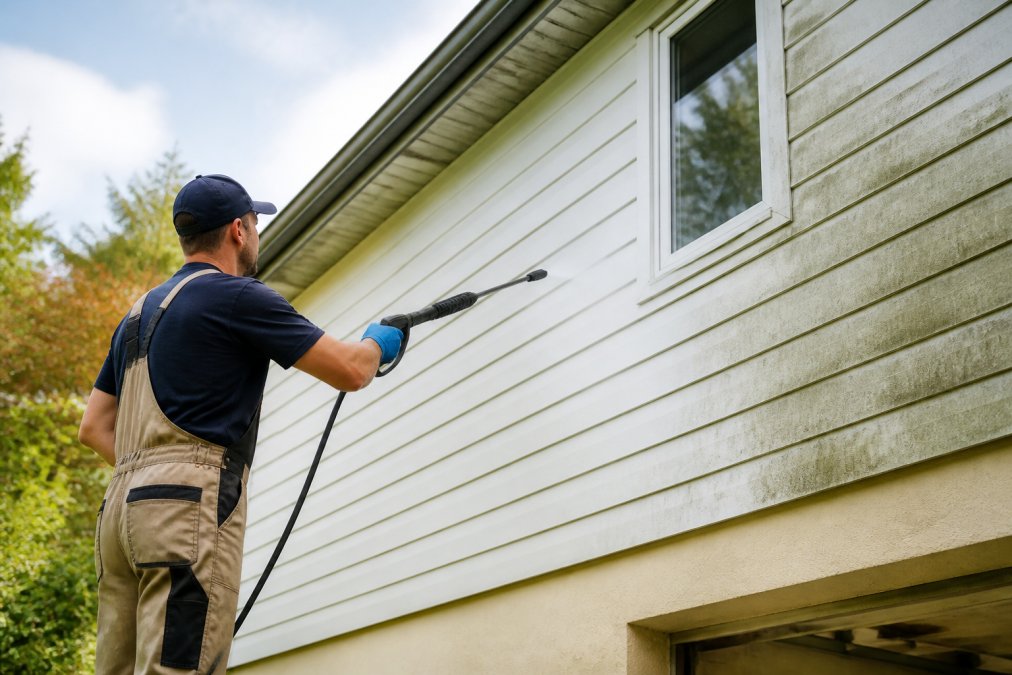
Homeowners often assume that the most effective way to clean an exterior is to hit it with the highest pressure possible. The benefits of professional soft washing tell a different story, one that prioritises the longevity of your surfaces over the speed of the rinse. This low-pressure cleaning method, which uses specialised solutions rather than force, is rapidly becoming the standard for protecting delicate materials like roofs and timber siding. This technique is applied daily to restore properties, and it has been observed how it prevents the structural damage that high-pressure damage can cause.
The core distinction is simple: professional soft washing relies on cleaning agents and chemical dwell time to break down organic matter, rather than relying on a powerful jet of water. This approach is not just a preference; it is often a necessity for certain materials.
What is Soft Washing and Why is it Different?
Soft washing is a cleaning method that combines low-pressure water with biodegradable solutions, including biocides and surfactants, to remove mould, algae, and grime from exterior surfaces. Unlike pressure washing, which uses high-pressure water to blast away dirt, soft washing uses chemistry to kill the contaminant at its root. This is the crucial difference: a pressure washer might remove the visible black spots, but soft washing eliminates the underlying mold spores and algae growth, which is why results last considerably longer.
The method is specifically designed for surfaces that cannot withstand the force of a high-pressure jet. Roof cleaning, for instance, demands this gentle approach. The cleaning agents are applied at low pressure, allowed to dwell on the surface to break down the organic material, and then rinsed off, protecting the integrity of the material beneath.
The Core Benefits of Professional Soft Washing
The primary advantage of professional soft washing is its ability to deliver a deep clean without sacrificing the integrity of your building materials. By targeting the source of the discolouration, the treatment provides surface sanitisation that prevents the rapid return of mould and mildew, leading to improved curb appeal and a higher property value.
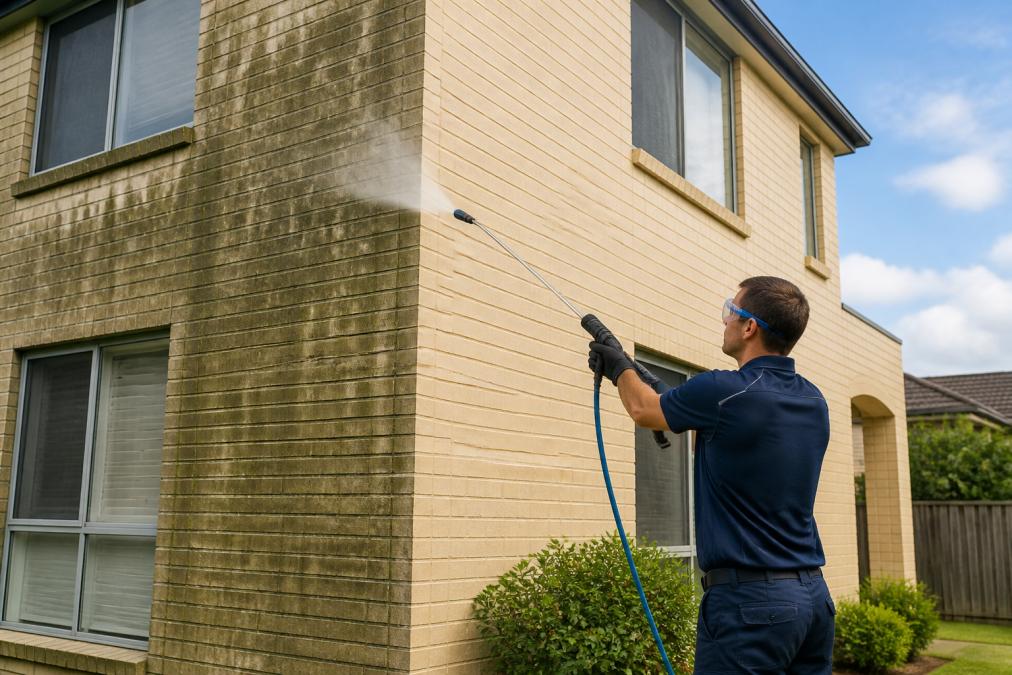
Beyond the immediate visual improvement, the preventative nature of this cleaning is a significant financial benefit. Regularly removing organic build-up prevents the degradation of paints, sealants, and the underlying material itself, extending the lifespan of your roof and siding and avoiding costly repairs.
The Science Behind the Solution: Why Biocides and Surfactants Matter
Most discussions of soft washing stop at the term ‘eco-friendly.’ The real advantage lies in the specific chemistry, built on two key components:
- Surfactants: These are wetting agents that reduce the surface tension of water. This allows the solution to spread evenly and penetrate the microscopic pores of surfaces like timber and render, rather than beading up and running off. This is critical for lifting embedded grime and ensuring the biocide reaches the root of the growth.
- Biocides: The active ingredients designed to kill organisms like mould, algae, and bacteria. A common and effective class of biocides used in professional soft washing are quaternary ammonium compounds (often referred to as ‘quats’). Unlike bleach (sodium hypochlorite), which can degrade certain materials and harm surrounding vegetation, quats are non-oxidising (peer-reviewed research). This means they break down organic matter without the corrosive side effects. They are also biodegradable, breaking down into harmless components in the environment.
The dwell time, the period the solution sits on the surface, is not a delay tactic; it is the mechanism of action. The biocide needs time to penetrate the cell walls of the organism and disrupt its biological processes. Rinsing too early washes away the active chemistry before it has done its job, which is why results are measured in years, not months.
The Environmental Advantage: Protecting Your Garden and Local Waterways
The ‘eco-friendly’ claim is often vague. In practice, the benefit is concrete: when a professional applies a biodegradable solution, the run-off that reaches your garden beds is designed to break down into non-toxic components, protecting soil health and preventing chemical burns to your plants.
Furthermore, because the cleaning is chemistry-based, the volume of water used is significantly lower than in pressure washing. A typical soft wash job uses a fraction of the water required for a high-pressure rinse, a direct benefit in Australia, where water restrictions are a recurring reality. Choosing a professional service that uses biodegradable, non-ionic surfactants and quat-based biocides ensures you are not trading a clean exterior for a poisoned garden or a contaminated stormwater system.
The Financial Benefit of Preventative Maintenance
The most compelling benefit is the long-term financial one. Soft washing is not just a cosmetic service; it is a maintenance strategy that prevents the conditions leading to rot, decay, and structural weakness.
Consider the lifecycle of a painted timber fascia. If algae and mould are allowed to flourish, they trap moisture against the paint film, causing it to blister and peel and exposing the raw timber to the elements. The cost of repainting a two-storey home is substantial; the cost of a professional soft wash to prevent that paint failure is a fraction of that expense. This is the core of cost-effectiveness: it is not about the price of the clean, but the value of the prevention. A professional service neutralises the surface, creating an environment inhospitable to future growth, extending the interval between necessary cleans and protecting your property’s most significant asset.
Soft Washing vs Pressure Washing: Choosing the Right Method
Choosing between soft washing vs pressure washing comes down to the surface you are cleaning and the type of stain you are removing. Pressure washing is the appropriate tool for hard, impervious surfaces like concrete driveways and paved pathways where the goal is to dislodge stuck-on dirt and grime. For residential exterior surfaces such as timber decks, vinyl cladding, and roofs, soft washing is the safer and more effective option.
| Feature | Soft Washing | Pressure Washing |
|---|---|---|
| Cleaning Force | Low-pressure + chemical action | High-pressure water only |
| Best For | Roofs, timber, painted surfaces | Concrete, brick, stone |
| Target Stains | Mould, algae, mildew | Dirt, grime, chewing gum |
| Result Longevity | Longer (kills organic roots) | Shorter (surface clean only) |
| Surface Risk | Low | High on delicate materials |
If you are dealing with algae growth or mildew removal on a porous or delicate surface, high-pressure water can actually force moisture deeper into the material and cause long-term issues. In practice, many cleaning jobs require both methods: a pressure wash for the concrete driveway and a soft wash for the house exterior and roof. Hiring a service that specialises in both ensures the right technique is applied to each specific area.
How to Remove Mould from House Exterior Safely
To remove mould from a house exterior safely, you must use a low-pressure application of a biocide that kills the organic matter, rather than scrubbing or blasting it off. Attempting to remove mould with a high-pressure washer is a common mistake that can force mold spores deeper into siding or damage the surface finish. The correct process involves applying a cleaning agent designed for exterior mould, allowing sufficient dwell time to penetrate and kill the growth, and then rinsing at low pressure.
- Assess the surface: Check the material type (timber, brick, render) to select the appropriate cleaning agent.
- Protect surrounding areas: Wet down garden beds and cover sensitive plants to prevent chemical damage.
- Apply the biocide: Use a low-pressure spray to apply the solution evenly across the affected area.
- Allow dwell time: Let the solution sit for 10-15 minutes to kill the mold spores and algae at the root (the EPA).
- Rinse gently: Use low-pressure water to wash away the dead organic matter and residue.
Attempting this as a DIY project with a rental machine from a hardware store often fails because the chemical dwell time is rushed or the correct solutions are not used. Without the right professional equipment and biodegradable solutions, the mould will typically return within a few months. A professional service not only removes the visible staining but also neutralises the surface to inhibit future growth.
Is Soft Washing Safe for Roof Surfaces?
Yes, soft washing is the safest and most recommended method for cleaning roof surfaces, as it protects shingle integrity while effectively removing black streaks and algae. Roofs are not designed to withstand the impact of high-pressure water; blasting them can dislodge granules, accelerating weathering and shortening the roof’s lifespan. Soft washing uses low pressure to apply a specialised solution that cleans without abrasive force.
The primary concern with roof cleaning is structural damage prevention. The black streaks seen on many roofs are a type of algae that feeds on the limestone filler in shingles. High-pressure washing only removes the surface stain, leaving the algae to return quickly. Professional soft washing uses a biocide that kills the algae, cleaning the roof and preventing premature aging of the materials. This method is also effective for cleaning gutters and downpipes without the risk of bending or detaching them with high-pressure water.
DIY vs. Professional Soft Washing: The Risks and Rewards
The main risk of DIY soft washing is the potential for chemical damage and personal injury, which is why hiring a professional is often the safer investment. While renting a machine may seem cost-effective initially, the costs of mistakes can be high. Getting the mix of cleaning agents wrong can etch glass, bleach gardens, or void your roof warranty. Furthermore, working at height on a roof with water and chemicals introduces significant safety risks that untrained homeowners underestimate.
The Equipment Gap: Why Consumer Gear Fails
The difference between a professional result and a DIY disappointment often comes down to the equipment. A consumer-grade sprayer from a hardware store is not designed for the precise application of chemical solutions.
- Pressure and Volume Control: Professional soft washing systems use low-pressure pumps, typically operating at 50-100 PSI (pounds per square inch) at a higher flow rate. This combination allows for a gentle but thorough application of the solution. A consumer pressure washer, even on its lowest setting, can still deliver 500-1000 PSI, which is far too aggressive for surfaces like roof shingles or timber cladding (the CDC). The risk is not just surface damage; it is forcing water and chemicals deep into the substrate, which can lead to internal rot and structural issues that are invisible until it is too late.
- Chemical Injection: Professional rigs have built-in chemical injection systems that draw the solution from a container and mix it with water at a precise ratio. This ensures a consistent concentration is applied across the entire surface. A DIY approach often involves manually mixing chemicals in a bucket and applying them with a pump sprayer. This leads to inconsistent coverage, too strong in one spot (risking damage) and too weak in another (failing to kill the growth).
- Nozzle Design: The nozzle on a soft wash wand is designed to create a wide, fan-like spray pattern that delivers the solution evenly without atomising it into a fine mist. A fine mist can drift onto unintended areas, such as windows or neighbouring properties, and can be inhaled. Professional nozzles produce larger droplets that fall directly onto the target surface, minimising drift and maximising dwell time.
The Chemical Knowledge Gap: More Than Just Mixing
Professional technicians are trained in the safe handling and application of biocides and surfactants. This is not just about knowing the correct dilution ratio; it is about understanding the interaction between the chemical and the specific surface.
- Surface Compatibility: A professional knows that a solution safe for vinyl cladding may not be suitable for copper gutters or certain types of natural stone. They assess the material first and select the appropriate chemistry.
- Health and Safety: Biocides, while effective, are still chemicals. Professionals are trained in the correct use of personal protective equipment (PPE), including gloves and eye protection. They also understand how to manage run-off to protect nearby plants and waterways, a responsibility that is often overlooked in a DIY context.
- Warranty Protection: Many roof and siding manufacturers have specific cleaning guidelines. Using the wrong chemical or high pressure can void the warranty on your materials. A professional service is familiar with these manufacturer requirements and will use methods that comply, protecting your investment.
The Real Cost of a DIY Mistake
A common pattern is for a homeowner to rent a machine, spend a weekend on the job, and achieve a result that looks good for a few weeks. The mould returns, or worse, the surface is damaged. The cost of rectifying a DIY mistake often exceeds the cost of hiring a professional in the first place.
Consider the scenario of a DIY roof wash. If the pressure is too high, the abrasive action can strip the protective granules from asphalt shingles, accelerating the weathering process and reducing the roof’s lifespan from 25 years to under 10. The cost of a premature roof replacement is in the tens of thousands of dollars; the cost of a professional soft wash is a few hundred. The risk-reward ratio is heavily skewed towards hiring a professional who understands the equipment and the chemistry.
Frequently Asked Questions
What is the difference between soft washing and pressure washing?
Pressure washing relies on high-pressure water to blast away dirt, which can damage delicate surfaces like roofs, timber, and vinyl cladding. Soft washing uses low-pressure water combined with specialised biodegradable cleaning solutions to safely kill and remove mould, algae, and grime at the root. This makes professional soft washing the safer choice for protecting your property’s exterior.
How long does a professional soft wash last?
The results of a professional soft wash typically last between 12 and 24 months. The longevity depends on your property’s environment, such as shade and humidity levels. Unlike pressure washing, which only cleans the surface, soft washing eliminates the organic growth at its source, helping to prevent regrowth and leaving you with long-lasting results.
Is soft washing environmentally friendly?
Yes, professional soft washing is an environmentally conscious choice. Reputable services, like Sydney Pressure Washing Service, use biodegradable cleaning solutions and apply neutralisers after cleaning. This ensures that the chemicals are safe for your gardens, pets, and local waterways, while still being highly effective at surface sanitisation and stain removal.
Why should I hire a professional instead of DIY soft washing?
DIY soft washing carries several risks. Without the correct professional equipment and knowledge of chemical dwell time, you can damage your siding, roof shingles, or plants. Professionals are trade-licensed and insured, protecting you from liability. They also know how to adjust the technique for different surfaces to prevent structural damage and ensure the mould doesn’t return.
