
Table of Contents
- Why Book Professional Commercial Property Cleaning for Your Business
- Commercial Cleaning Rates Per Hour: What Drives the Price
- How to Prepare for Strata Cleaning Inspections
- What Belongs in a Commercial Cleaning Service Agreement Template
- How to Book Professional Commercial Property Cleaning: Step by Step
- Green Cleaning and Cost-Benefit Analysis of Outsourcing
- Frequently Asked Questions
Last Updated: September 13, 2026
Why Book Professional Commercial Property Cleaning for Your Business
Booking professional commercial property cleaning is the most reliable way to meet your duty of care, protect asset value, and keep a premises inspection-ready.
Commercial property cleaning is the scheduled cleaning and maintenance of business premises, including offices, retail spaces, industrial sites, and strata common areas, carried out by trained professional cleaners under a defined scope and service level agreement.
That definition matters because the obligations behind it are legal, not cosmetic. Under work health and safety legislation administered by Safe Work Australia, a person conducting a business or undertaking must keep the workplace clean and safe so far as is reasonably practicable. Cleaning is part of that duty, not an optional extra.
Cleaning is a compliance activity before it is a presentation activity. If you cannot show a schedule, a scope, and a record of completion, you cannot easily show you met your duty of care.
Compliance, Safety and Duty of Care
A commercial cleaning contract should map directly to your workplace hygiene and safety obligations: documented standards for high-touch surfaces, waste management, and floor care, plus safe systems of work for the cleaners.
Ask any provider how they handle chemical safety, working at height for window cleaning, and electrical safety around equipment. A compliance-led provider will have written procedures and trained staff. One that cannot describe them is a liability you are importing onto your site.
The Real Cost of Cutting Corners on Workplace Hygiene
Skipping regular cleaning rarely saves money. It shifts cost into reactive deep cleans, premature replacement of floors and fittings, and lost staff time, while poorly maintained entries shape how clients and tenants judge a building.
Treating cleaning as a line item to trim first is a mistake: the buildings that cost least to run are cleaned to a documented schedule, so problems are caught while they are small.
Commercial Cleaning Rates Per Hour: What Drives the Price
Commercial cleaning rates per hour reflect labour, access, frequency, and specialist tasks, so two quotes for the same floor area can differ significantly. Treat pricing as an output of your site’s conditions, not a flat market rate.
Frequency, Access and Site Size
Daily cleaning costs more per month than weekly maintenance, but the hourly rate often drops because staff are routed efficiently. Site size, amenities, and travel time between levels all move the number.
Access is the quiet cost driver. After-hours service, lift bookings, security sign-in, and restricted zones add labour hours that never appear on the floor plan.
| Quote Factor | Low Impact on Rate | High Impact on Rate |
|---|---|---|
| Frequency | Fortnightly maintenance | Daily cleaning |
| Access | Open during business hours | After-hours, escorted access |
| Site size | Single open floor | Multi-level, multiple amenities |
| Tasks | Vacuum, mop, bins | Window cleaning, floor care, disinfection |
| Compliance | Standard scope | Documented SLA and audit trail |
Specialist Tasks That Change the Quote
Specialist work sits outside a standard contract and is quoted separately. Industrial cleaning, high-level window cleaning, pressure washing of hardstand areas, and disinfection all require different equipment and training.
Ask for specialist tasks to be priced as separate line items. Bundling them into one monthly figure hides what you are actually paying for and makes it hard to cut scope later without renegotiating the whole contract.
How to Prepare for Strata Cleaning Inspections
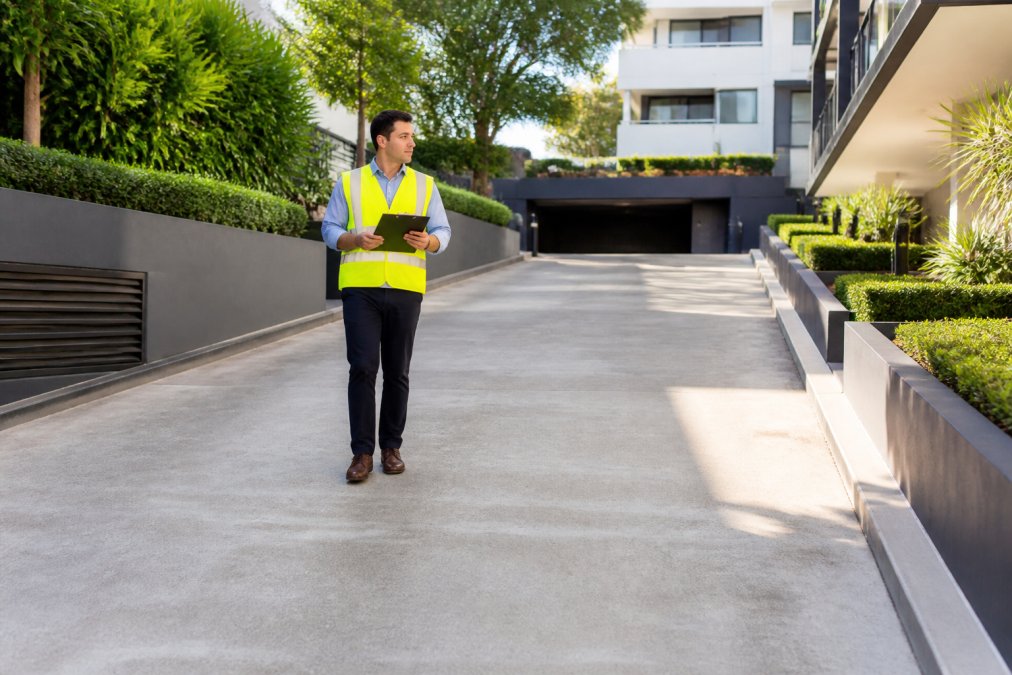
Preparing for strata cleaning inspections starts with a walk-through against the agreed schedule, documented with photos and dated notes, before the inspection date. The standard a strata committee applies is not aesthetic, it is whether the owners corporation has met its obligation to keep common property in good and serviceable repair.
That obligation sits in state and territory strata schemes management legislation, administered by the relevant consumer affairs or fair trading regulator (nsw.gov.au). If common property is not maintained, the owners corporation can face orders, insurance disputes, and levy-funded remediation. Cleaning records are the cheapest evidence you will ever produce.
What Counts as Common Property
Before you can inspect it, you need to know what you are responsible for. Common property typically includes:
- Entry foyers, lobbies, corridors, and stairwells
- Lifts, lift shafts, and lift car interiors
- Shared amenities such as bin rooms, laundry areas, and mailrooms
- Car parks, driveways, pathways, and hardstand areas
- External walls, awnings, signage, and garden edging
- Roof spaces, gutters, and drainage that serve more than one lot
Anything inside a lot boundary is generally the owner’s responsibility. Disputes start when that line is blurred, so confirm the boundary against the registered strata plan before building a cleaning scope.
The Pre-Inspection Walk-Through
Work through the common property methodically, in the same order every time, so nothing is skipped:
- Entry foyers, lifts, and stairwells free of marks and debris
- Bin rooms and waste management areas washed and odour-free
- Car parks, driveways, and pathways free of oil stains and moss
- External walls, awnings, and signage free of mould and cobwebs
- Garden edging and hardstand areas clear and presentable
- Drainage grates and pits clear of litter and sediment
- Signage and lighting fixtures dusted and legible
Photograph each area on the same day, from the same angle, to show change over time. A before-and-after pair persuades a committee far more than a written assurance.
Keeping Evidence That Stands Up
Keep a simple log of each clean: date, areas covered, products used, and issues raised. It answers inspection questions faster than memory and demonstrates a pattern of maintenance rather than a one-off tidy-up.
An inspection is not a test of how the building looks on the day. It is a test of whether you can show a maintained schedule. The log is the asset, not the mop.
By-Laws, Access, and Resident Coordination
Cleaning common property often means entering areas residents treat as semi-private. Check by-laws for quiet hours, pet restrictions, and notice requirements before scheduling external works. For after-hours access, confirm whether the strata or building manager must authorise entry, and keep a record.
Route resident concerns through the strata manager rather than negotiating directly. That keeps the paper trail in one place and prevents informal promises becoming contractual expectations.
What to Do When an Issue Is Found
When the walk-through surfaces a defect, cracked paving, failed waterproofing, a leaking downpipe, log it and escalate it to the strata manager in writing. Cleaning removes the symptom, not the cause; distinguishing the two protects the provider from blame and gives the committee what it needs to budget for repair.
What Belongs in a Commercial Cleaning Service Agreement Template
A commercial cleaning service agreement template should define scope, frequency, standards, access, insurance, and termination in plain language, removing ambiguity before work starts.
Clauses That Protect Both Sides
- Scope and schedule: exactly what is cleaned, how often, and to what standard
- Service level agreement: measurable cleaning standards and response times for issues
- Insurance and licensing: current public liability cover and relevant licences, with certificates provided
- Access and security: key handling, alarm codes, sign-in procedures, and vetting of staff
- Variations: how specialist or one-off tasks are quoted and approved
- Termination: notice periods and handover requirements
The service guarantee clause is the one most often left vague. It should state what happens if a standard is missed and how quickly the provider returns to fix it.
How to Book Professional Commercial Property Cleaning: Step by Step
Booking professional commercial property cleaning follows six steps: define your scope, request quotes, verify credentials, agree the schedule, sign the agreement, and set a review date. The sequence prevents expensive rework.
- Define your scope. List every area, task, and frequency you need, including specialist work.
- Request an obligation-free quote. Ask for itemised pricing, not a single monthly figure.
- Verify credentials. Confirm licensing, insurance, and staff vetting in writing.
- Agree the schedule and access. Lock in daily, weekly, or after-hours service and how cleaners enter.
- Sign the agreement. Confirm the service level agreement, guarantee, and variation process.
- Set a review date. Check performance against the schedule within the first month.
Vetting, Insurance and Security Protocols
Security and vetting protocols separate a professional provider from a casual arrangement. Ask how staff are screened, how keys and access codes are controlled, and who is accountable if something goes wrong.
Insurance is not a formality. Request a current certificate of currency for public liability and confirm it covers the work, including work at height or chemical use.
Building a Cleaning Checklist for Facility Managers
A cleaning checklist turns a contract into something you can actually manage. Build one checklist per area, tied to the frequencies in your agreement, and use it at every site walk.
| Area | Task | Frequency |
|---|---|---|
| Entry and foyer | Mop, glass, high-touch disinfection | Daily |
| Amenities | Full clean and restock | Daily |
| Car park and hardstand | Sweep, pressure wash, stain removal | Monthly |
| External walls and awnings | Soft wash, mould treatment | Quarterly |
| Windows | Internal and external clean | Quarterly |
Do not sign a contract that lists areas but not frequencies. Without a stated frequency, a provider can meet the letter of the agreement while your building still looks neglected, and you have no grounds to escalate.
Green Cleaning and Cost-Benefit Analysis of Outsourcing
Green cleaning and outsourcing decisions are best assessed together, because they reinforce each other. A provider using biodegradable solutions and neutralisers reduces chemical load on your site, while a contract shifts equipment, training, and labour costs off your books. But the case only holds if you can put numbers against it.
A Simple Cost-Benefit Method You Can Run Yourself
The cost-benefit case for outsourcing rests on four figures. Work through them in order and the comparison usually resolves itself.
- Fully loaded in-house labour cost. Take the hourly rate you pay, then add superannuation, workers compensation, payroll tax where it applies, leave entitlements, training time, and recruitment cost. The loaded figure is typically well above the advertised hourly rate.
- Equipment and consumables. Add the purchase price, depreciation, servicing, and replacement cycle for vacuums, scrubbers, pressure washers, and chemical stock. Include storage space if it displaces revenue-earning area.
- Management and downtime. Estimate the hours your facility or office manager spends rostering, supervising, and covering absences. Then estimate the cost of reactive deep cleans when a surface fails early.
- Contract cost. Use the itemised quote, not the headline monthly figure, and separate scheduled work from specialist tasks.
Compare totals over twelve months, not one. In-house often looks cheaper on the hourly rate and more expensive on the loaded rate, particularly once absence cover and equipment replacement are included.
Run the comparison twice: once assuming no staff turnover, and once assuming one resignation and one extended absence. The second scenario is the realistic one, and it is where outsourcing usually pulls ahead.
What Green Cleaning Actually Means in Practice
Sustainability is where tenant expectations have moved fastest. Tenants and staff increasingly ask what is used on their building, and a provider that can explain its products and disposal methods answers directly.
Green cleaning is not a single product choice. It is a set of practices:
- Chemical selection. Biodegradable detergents, pH-neutral cleaners for delicate surfaces, and neutralisers to protect surrounding paving and planting.
- Dilution control. Pre-measured dosing rather than glugging from a bottle, which cuts both chemical use and surface damage.
- Water efficiency. Low-flow pressure washing, reclaim where practical, and sweeping before washing to reduce runoff.
- Waste separation. Segregating recyclables, organics, and general waste at the bin room rather than at the tip.
- Indoor air quality. Low-volatile-organic-compound products and adequate ventilation during and after cleaning.
For guidance on environmentally preferable cleaning products, the GECA environmental certification standards provide an independent reference point. Ask any provider which of their products carry independent certification, and ask for the safety data sheets.
The Equipment Argument
Outsourcing also brings equipment most businesses never buy: pressure washing units, soft washing rigs, and neutralisers for delicate surfaces.
Buying that equipment in-house means capital outlay, servicing, storage, and trained operators; renting per job means coordinating multiple suppliers. A contract folds all three into one line item, which is why the comparison tends to favour outsourcing once specialist tasks enter the scope.
Where Outsourcing Does Not Win
Be honest about the exceptions. If your site is small, single-level, and cleaned lightly, in-house can be cheaper because the fixed overhead of a contract is hard to justify. With unusual security requirements, a team you have vetted yourself may be simpler than onboarding a contractor.
The right answer depends on your site, not on a general rule. Run the four-figure method above with your own numbers before you decide.
Frequently Asked Questions
How much do commercial cleaners charge per hour in Australia?
Commercial cleaning rates per hour vary with site size, frequency, access requirements and the tasks involved. Regular daily or weekly maintenance usually costs less per hour than one-off deep cleans or after-hours service. Specialist work such as high-pressure washing, window cleaning at height or disinfection services attracts a higher rate because of equipment and licensing. Request a free quote based on your actual premises rather than comparing headline hourly figures.
How do I prepare for strata cleaning inspections?
Walk the common property first and note problem areas: mould on paths, stained driveways, clogged drains and grimy bin bays. Clear access to those zones, confirm which surfaces are delicate, and share any building maintenance schedules with your contractor. Ask for before-and-after photos and a written scope. A clear, documented brief means the inspection covers the same ground your cleaners worked on, with no surprises for the strata committee.
What should a commercial cleaning service agreement template include?
A workable agreement covers the scope of works, cleaning schedule, service level agreement targets, rates, contract length and termination notice. Add clauses on insurance, police checks for staff, key handling, incident reporting and the service guarantee. Include a section for variations, so extra tasks such as waste management or floor care are quoted separately. Both parties should sign before the first clean, and review the document annually.
How often should a commercial property be professionally cleaned?
Most offices and retail sites need daily cleaning of high-touch areas and weekly maintenance of floors, glass and washrooms. Industrial and healthcare premises often require more frequent disinfection services. Exterior work such as pressure washing, window cleaning and waste management typically runs monthly or quarterly, depending on weather and foot traffic. Your contractor should recommend a schedule after inspecting the site.
