
Table of Contents
- What a Strata Driveway Cleaning Service Actually Covers
- What Drives the Cost of Strata Cleaning in 2026
- Building a Strata Maintenance Schedule That Works
- Pressure Cleaning Compliance Requirements for Strata Sites
- How to Choose a Strata Cleaning Contractor
- Seasonal Timing and the Return on Regular Driveway Maintenance
- Conclusion: Booking Your Strata Driveway Cleaning Service
- Frequently Asked Questions
Last Updated: September 26, 2026
What a Strata Driveway Cleaning Service Actually Covers
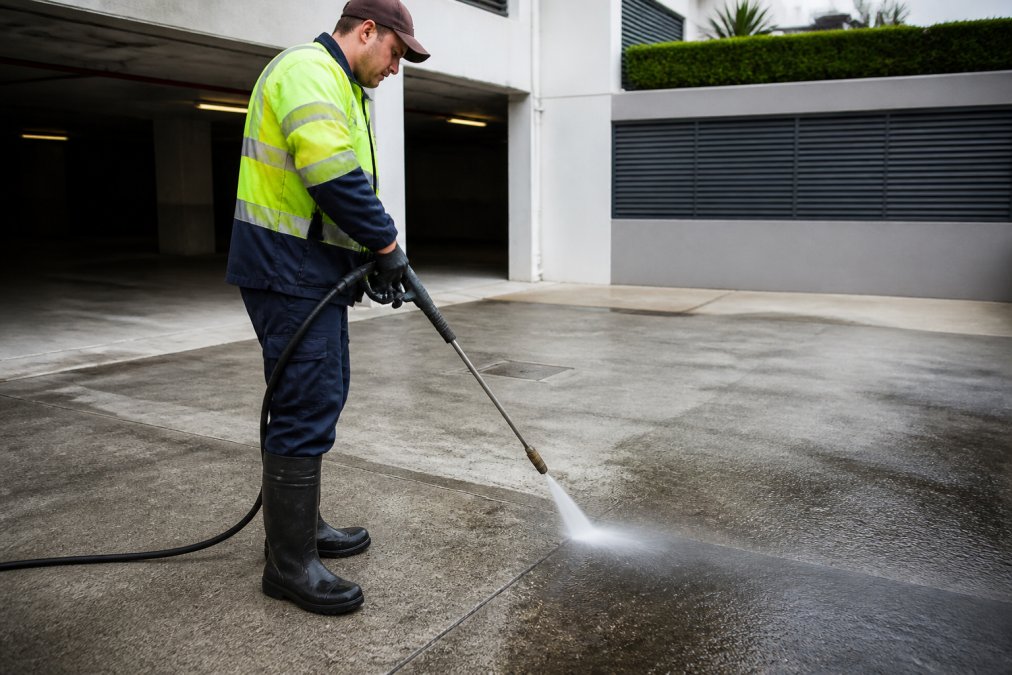
A strata driveway cleaning service is a scheduled exterior cleaning program for the shared vehicle and pedestrian surfaces of a residential or commercial complex. At Sydney Pressure Washing Service, we treat it as asset maintenance rather than a one-off tidy-up: concrete driveways, basement and open car parks, walkways, entry stairs, bin areas, loading zones and the building facade above them.
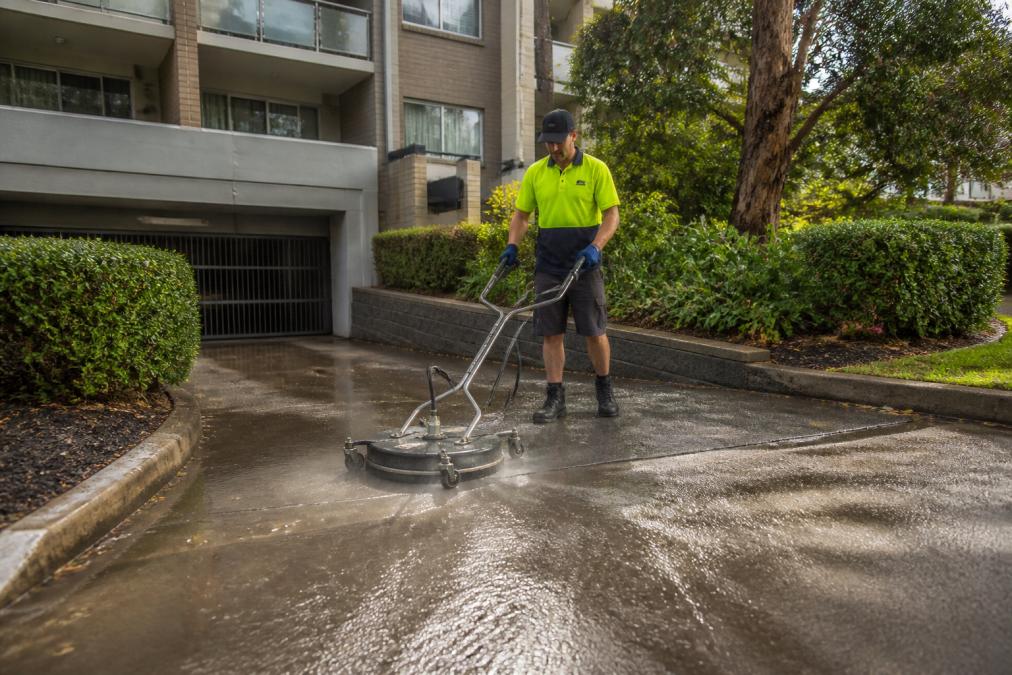
The scope usually breaks down into five jobs:
- Pressure cleaning of driveways, ramps and common pathways
- Car park sweeping, oil stain treatment and line marking clean-up
- Walkway and entry cleaning, including stairs and handrails
- Graffiti removal and surface restoration on walls and pillars
- Gutter cleaning and facade spot-cleaning where access allows
High-Pressure Washing vs Soft Washing on Common Property
Not every surface on a strata site can take full pressure. Concrete driveways and car parks handle industrial grade equipment well. Timber decks, painted render, vinyl cladding and roof sheeting do not. Soft washing uses lower pressure with biodegradable cleaning solutions and neutralisers, which lifts mould, algae and grime without stripping coatings or driving water behind cladding.
What Drives the Cost of Strata Cleaning in 2026
Pricing depends on surface area, access, contamination level and how often you book. A single driveway on a small residential complex costs far less than a multi-level basement car park with oil staining and restricted drainage. There is no honest flat rate, and any provider quoting one without a site visit is guessing.
The main cost variables are:
| Cost Driver | Why It Matters |
|---|---|
| Total surface area | Measured in square metres, not “one driveway” |
| Surface type | Concrete is straightforward; timber and render need soft washing |
| Contamination | Oil stains, moss and algae take longer than general grime |
| Access and drainage | Basements and tight ramps slow equipment movement |
| Frequency | Scheduled plans spread cost and reduce per-visit pricing |
Ask for a quote that separates pressure cleaning from soft washing and graffiti removal. Bundled lump sums hide where the money goes, and you cannot compare providers fairly without the breakdown.
How to Get an Accurate Free Quote
An accurate quote needs a site walk-through, photos of the worst areas, and a clear list of surfaces. Give the contractor your complex size, number of units, parking levels and any known problem spots. Ask what is excluded, how runoff is managed, and whether the price holds for the full schedule.
Building a Strata Maintenance Schedule That Works
A strata maintenance schedule is a written plan setting out which surfaces get cleaned, how often, and who signs off. Frequency should follow exposure, not habit. Driveways and entries in high-traffic complexes need more attention than a quiet rear walkway.
A practical baseline looks like this:
- Monthly: car park sweeping, bin area wash-down, entry cleaning
- Quarterly: full driveway and walkway pressure cleaning
- Six-monthly: facade spot-cleaning, gutter cleaning, graffiti check
- Annually: deep clean, surface restoration and concrete sealing review
Pressure Cleaning Compliance Requirements for Strata Sites
Pressure cleaning compliance requirements cover water use, runoff containment, chemical handling and work health and safety on shared property. In practice, that means managing where wastewater goes, protecting stormwater drains, and keeping residents and pets clear of active work zones. Most competitors stop at that sentence. The useful detail is which obligations actually attach to the job, and who carries them.
Who Is Responsible for What
Responsibility splits three ways, and strata managers who understand the split avoid most disputes:
- The owners corporation controls the common property and is the entity that can be pursued if pollution leaves the site. It also owes duties to residents and visitors under work health and safety law.
- The contractor controls the work method, the equipment and the runoff. As the person conducting the business or undertaking, the contractor carries the primary duty to manage risks arising from the work.
- The strata manager is usually the approving officer. Signing off a scope without checking runoff method, insurance and chemical handling transfers risk back to the owners corporation.
Runoff, Water and Environmental Obligations
Wastewater from pressure cleaning carries dirt, oil, detergent and biological matter. It must not flow untreated into stormwater drains, which discharge to waterways (Guidance for stormwater management: the drain is just for rain). The regulatory backdrop is state-based: the Environment Protection Authority in New South Wales regulates pollution of waters, and local councils administer stormwater and trade waste requirements under their own local approvals.
A compliant runoff plan normally includes:
- Containment at the source, bunding, booms or vacuum recovery around the work area rather than letting water run to the nearest pit.
- Diversion away from stormwater, blocking or sealing gutter inlets and redirecting to a collection point.
- Recovery and disposal, capturing wastewater and disposing of it to sewer under a trade waste arrangement, or to an approved liquid waste facility. It should never be tipped onto garden beds or the nature strip.
- Biodegradable chemistry with neutralisers, particularly where runoff may contact landscaping or where the surface drains toward a sensitive area.
- Pre-work protection, covering garden beds, sealing basement drains and shielding neighbouring property from overspray.
Booking a contractor who lets wastewater run straight into the street drain exposes the owners corporation to environmental penalties and complaints. Ask for the runoff method in writing before you approve the job.
Chemical Handling and Surface Compatibility
Detergents, degreasers, mould treatments and graffiti removers all carry their own handling requirements. Ask for safety data sheets for every product proposed, confirm they are stored and decanted safely on site, and check that the dilution rates suit the surface. A degreaser strong enough for a basement car park can etch or discolour painted render if it is applied at the same strength.
Work Health and Safety on Occupied Sites
Strata cleaning happens around residents, pets, vehicles and sometimes children. A workable safety setup covers:
- Traffic and pedestrian management around ramps, entries and car park aisles
- Exclusion zones with signage and, where needed, physical barriers
- Electrical safety for pressure equipment and any leads run across wet ground
- Working at height controls for facade, gutter and awning work
- Emergency procedures and a site-specific risk assessment, not a generic one
Insurance and Documentation to Request
Before approving any job, collect and keep on file:
- A current certificate of currency for public liability cover
- A certificate of currency for the contractor’s own workers compensation, or evidence of the correct coverage for any subcontractors
- Trade licensing evidence where the work requires it
- Safety data sheets for all chemicals
- A written scope that names the runoff method and disposal point
- A site-specific risk assessment and safe work method statement where the work is high risk
Keep compliance documents with the maintenance schedule, not in a separate folder. When a committee changes or a dispute arises, the paper trail is the defence.
Records Worth Keeping
A simple compliance file for each visit should hold the date, the surfaces cleaned, the products used, the runoff method applied, any incidents, and before-and-after photos. That record supports the owners corporation if a complaint is made, and it demonstrates that the committee has been discharging its duties rather than reacting after the fact.
How to Choose a Strata Cleaning Contractor
Choosing a strata cleaning contractor comes down to four checks: licensing and insurance, equipment, surface knowledge, and reporting. A trade-licensed, fully insured provider protects the owners corporation if something is damaged. Industrial grade equipment separates a professional clean from a hired machine and a garden hose.
Step 1: Define the Scope Before You Seek Quotes
Write the scope first. It should list every surface, its approximate area in square metres, the cleaning method for each, the frequency, the runoff method, and what is explicitly excluded. A scope written after quotes arrive is a scope written around the cheapest bid.
Step 2: Shortlist on Capability, Not Price
Ask each provider for evidence of comparable work, multi-level basements, tight ramps, heritage facades, mixed residential and retail sites. A residential driveway specialist may be excellent and still be the wrong fit for a basement car park with no drainage fall.
Step 3: Verify Insurance and Licensing Properly
Do not accept a verbal assurance. Request:
- Certificate of currency for public liability insurance, with the policy period current
- Certificate of currency for workers compensation, or confirmation of how subcontractors are covered
- Trade licensing evidence where the work requires it
- Safety data sheets for all chemicals proposed
- A written runoff and disposal method
Check that the policy is current on the date of the work, not just the date of the quote. Policies lapse between quoting and scheduling more often than committees expect.
Step 4: Compare Quotes Like for Like
A quote is only comparable if it uses the same scope. Ask every provider to price the same surface list, the same frequency and the same runoff method. Where a provider proposes a different approach, ask them to price the original scope as well so the committee can see the difference.
Step 5: Agree the Contract Terms
A strata cleaning contract should set out:
- The scope and frequency, with a schedule attached
- The rate, and how variations are priced and approved
- The notice period and termination terms
- Insurance and licensing obligations that continue for the life of the contract
- Reporting requirements, including before-and-after photos and a visit log
- Access arrangements, including keys, fobs, after-hours work and resident notification
- Incident and complaint handling
Step 6: Onboard and Review
For the first visit, walk the site with the contractor and confirm the surfaces, the runoff points and the access arrangements. After each visit, review the photo record against the schedule. At the end of the first quarter, sit down with the committee and decide whether the frequency is right.
The cheapest quote is rarely the cheapest outcome. A provider without current insurance, a written runoff method or a proper scope exposes the owners corporation to costs that dwarf the saving on the clean.
Red Flags to Walk Away From
- A flat rate quoted without a site visit
- No certificate of currency, or a policy that expires before the work date
- No written runoff method
- No safety data sheets
- A scope that bundles pressure cleaning, soft washing and graffiti removal into one line item
- No before-and-after photo record offered
- Pressure to sign before the committee has met
The one drawback with cheapest-quote selection is predictable: no insurance, no runoff control, and surface damage that costs more to fix than the clean saved.
Seasonal Timing and the Return on Regular Driveway Maintenance
Timing a strata driveway cleaning service around the seasons protects both appearance and surfaces. Late winter and early spring are peak for moss and algae removal, because moisture has fed growth through the cooler months. Summer suits concrete sealing, when surfaces dry properly. Autumn is the window for gutter cleaning before leaf load builds.
Conclusion: Booking Your Strata Driveway Cleaning Service
Getting a strata driveway cleaning service right is about protecting a shared asset, not just tidying a driveway. Sydney Pressure Washing Service offers trade-licensed teams, both high-pressure and soft washing, and biodegradable solutions with neutralisers for safe, environmentally conscious results across concrete, timber and roof surfaces. Request a FREE QUOTE and we will walk your site, scope the surfaces, and build a maintenance schedule that fits your complex.
Frequently Asked Questions
How much does strata driveway cleaning cost?
Pricing depends on the size of the common property, the number of surfaces involved, access and how much oil staining or moss needs treating. A single driveway on a small complex sits at the lower end, while a full car park, walkways and building facade push the figure up. Because every site differs, the reliable path is a free on-site quote. Sydney Pressure Washing Service lists current rates on its website pricing page, so you can compare before booking.
How often should strata driveways be professionally cleaned?
Most residential complexes do well with a deep clean every 6 to 12 months, plus spot treatments for oil drips and graffiti as they appear. Sites with heavy tree cover, coastal salt exposure or high traffic need attention closer to the 6-month mark. A strata maintenance schedule that alternates full pressure cleaning with lighter touch-ups keeps concrete, pavers and walkways looking presentable year round and stops moss and algae from taking hold.
What is the difference between pressure washing and soft washing for strata surfaces?
Pressure washing uses high-pressure water to strip grime from hard surfaces such as concrete driveways and car parks. Soft washing applies low pressure with biodegradable cleaning solutions, which suits timber decking, painted cladding, render and roofs where a harsh jet can etch or crack the finish. A capable strata driveway cleaning service carries both methods and matches the technique to each surface, so one visit can cover concrete, timber and garden edging without damage.
Are there environmental rules for pressure cleaning on strata property?
Yes. Runoff from cleaning can carry detergent, oil residue and sediment into stormwater, which flows to waterways untreated. Contractors should contain and capture wastewater where possible, use biodegradable solutions, and avoid discharging into drains. Work health and safety obligations also apply to the site, including traffic control around car parks and safe handling of any chemicals. Ask any provider how they manage runoff and which products they use before work begins.
Book early, because the best contractors fill their schedules well before the seasonal rush.
