
Table of Contents
- Why Exterior Cleaning Safety Matters More Than You Think
- Essential Pressure Washing Safety Precautions
- Chemical Handling, Detergent Dilution and First Aid
- Best Practices for Soft Washing Delicate Surfaces
- Preventing Surface Damage, Ladder Falls and Plant Loss
- How to Prepare House for Sale With Safe Exterior Cleaning
- Equipment Maintenance and When to Call a Professional
- Frequently Asked Questions
Last Updated: September 23, 2026
Why Exterior Cleaning Safety Matters More Than You Think
Exterior house cleaning safety tips matter because a pressure washer can strip paint, crack timber and send water into live wiring in seconds. This guide covers the safety steps that protect you, your home and your garden.
Essential Pressure Washing Safety Precautions
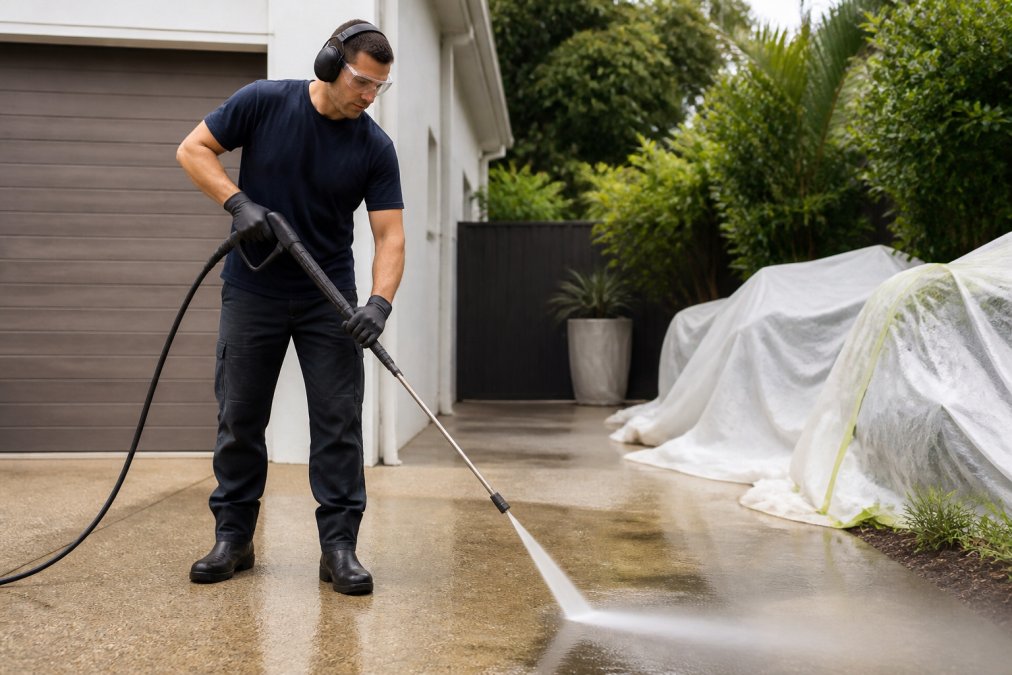
Pressure washing safety precautions start with three things: eye protection, gloves and non-slip footwear. Skip any one and you risk injury within minutes.
Personal Protective Equipment You Should Never Skip
Personal protective equipment is your first line of defence. A high-pressure injection injury can push water through skin and into tissue. It needs surgery, not a bandaid.
Wear these every time:
- Safety goggles or a full face shield
- Chemical-resistant gloves matched to your cleaning agents
- Non-slip footwear with closed toes
- Ear protection for gas-powered units
- Respiratory protection when spraying mould treatments
Electrical Hazards and Outdoor Outlet Protection
Electrical hazards cause the most serious accidents in exterior cleaning. Water and live current do not mix.
Also:
- Keep the wand at least 3 metres from power points
- Never spray upward near overhead power lines
- Check cords for cracks before plugging in
- Wear rubber-soled boots on wet concrete
Spraying near an outdoor outlet without a ground fault circuit interrupter can cause electrocution. Test the device before you start, every single time.
Chemical Handling, Detergent Dilution and First Aid
Detergent dilution protects your surfaces, your skin and your garden. Too strong and you etch concrete, strip sealant or scorch foliage. Too weak and mould returns within weeks. Getting the ratio right is the difference between a clean wall and a costly repair.
Read the Label Like It Matters
Every cleaning agent sold for exterior use carries a safety data sheet and a dilution table. Follow it. Common working ratios for exterior detergents sit between 1:10 and 1:30 with water, but the correct figure depends on the active ingredient.
Know what you are handling:
- Sodium hypochlorite, the active in most mould and algae treatments. Corrosive to skin, eyes and lungs. Never mix with ammonia or acids; the reaction releases toxic gas.
- Surfactants and degreasers, usually milder, but can strip wax and irritate skin with prolonged contact.
- Acidic descalers, used on mineral staining. Aggressive to skin, metal and some stone. Neutralise surfaces after use.
- Caustic degreasers, high pH, dangerous to eyes. Rinse thoroughly and never let them pool on concrete.
First Aid for Chemical Exposure
Skin contact:
- Remove contaminated clothing, jewellery and footwear immediately, do not let fabric hold the chemical against skin.
- Flush the area with cool running water for at least 20 minutes (Chemical burns, first aid and treatment). Use a gentle stream, not a hard jet, so you do not drive chemical deeper into tissue.
- Do not neutralise with another chemical. You will create heat and a second injury.
- Call 000 if the burn is larger than a palm, blistered, or caused by a caustic or concentrated acid.
- Take the product label or safety data sheet to the hospital. Paramedics and emergency staff need the active ingredient to treat correctly.
Eye exposure:
- Hold the eyelid open and flush from the inner corner outward so contaminated water does not run into the other eye.
- Flush continuously for at least 15 minutes. Do not stop to check the eye, keep flushing.
- Remove contact lenses if you can do so without delay.
- Seek emergency medical care immediately, even if the eye feels fine afterwards. Chemical burns to the cornea can worsen over hours.
Inhalation:
Move to fresh air immediately. If breathing is difficult, call 000. Do not re-enter the area until it is ventilated.
Ingestion:
Never mix cleaning chemicals. Sodium hypochlorite plus an acidic descaler releases chlorine gas. Sodium hypochlorite plus ammonia releases chloramine vapour. Both can cause serious lung injury in an enclosed area.
Environmental Runoff Management
Chemical runoff kills garden beds and pollutes stormwater. It is a genuine regulatory and environmental concern, many councils treat detergent-laden runoff entering the stormwater system as a pollution event.
Before you start:
- Cover drains with sandbags or absorbent socks so runoff cannot enter the stormwater system.
- Pre-wet plants and rinse them after. Dry foliage absorbs detergent; wet foliage resists it.
- Use biodegradable solutions where the surface allows.
- Never let runoff flow into the street drain. Stormwater is not treated before it reaches waterways.
- Work in sections and rinse as you go, rather than letting chemical pool and travel.
Rinsing plants before and after spraying is the single best way to stop detergent burn.
Best Practices for Soft Washing Delicate Surfaces
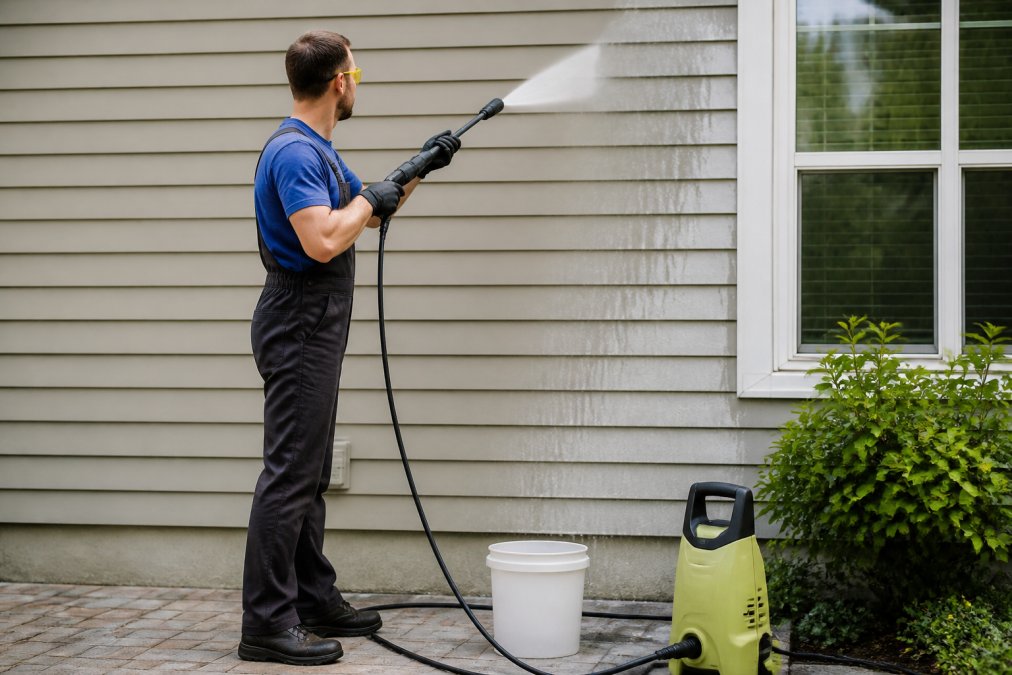
Best practices for soft washing begin with lower pressure and gentler chemicals. Soft washing uses under 500 PSI, compared with 3,000+ for pressure washing.
It suits:
- Timber decks and weatherboards
- Roof tiles and metal roofing
- Vinyl cladding and painted render
- Screens, gutters and garden edging
Preventing Surface Damage, Ladder Falls and Plant Loss
Surface damage happens when pressure, nozzle angle and dwell time combine badly. Pressure alone is only part of the story. A 1,500 PSI jet held at zero degrees against timber will gouge it faster than a 3,000 PSI fan tip swept across concrete.
Why Materials Fail at Different Pressures
Each surface has a threshold where the water jet overcomes the material’s own strength:
- Concrete and pavers, dense and porous. Handles 2,500-3,000 PSI, but too close a nozzle etches the cream off the surface and leaves permanent stripes.
- Brick, fired clay with mortar joints. 1,500-2,000 PSI. Above that, mortar erodes and the wall loses weatherproofing.
- Timber, soft grain lifts and furs under high pressure. 500-1,200 PSI. Decking boards and weatherboards can splinter at the low end if the nozzle is too close.
- Painted surfaces and render, the coating fails before the substrate. Under 1,500 PSI, and always test a hidden patch first.
- Vinyl cladding, can crack or drive water behind panels. Soft wash only.
- Roof tiles and metal roofing, fragile underfoot and easily displaced. Soft wash only.
Nozzle Selection and Technique
Nozzle colour tells you the spray angle, and the angle controls the damage risk:
- 0° (red), pencil jet. Never use on a house exterior. It cuts.
- 15° (yellow), aggressive stripping. Concrete only, and only when needed.
- 25° (green), general cleaning. The default for hard surfaces.
- 40° (white), gentle rinse. Safe for most cladding and painted surfaces.
- Soap nozzle (black), low pressure, high flow. Use for detergent application.
Ladder Safety and Fall Prevention
Ladder stability saves lives. Falls remain one of the most common serious injuries in exterior work.
- Set the ladder on firm, level ground. Never on a slope without a levelling foot.
- Use the 4-to-1 rule: for every 4 metres of height, the base sits 1 metre out from the wall.
- Extend the ladder at least 1 metre above the landing point.
- Keep three points of contact, two hands and one foot, or two feet and one hand.
- Never overreach. Move the ladder instead.
- Wear non-slip footwear. Wet rungs are slippery, and detergent makes them worse.
- Have a second person foot the ladder on soft ground.
Protecting Plants and Landscaping
Plants suffer from two things: chemical contact and physical blast.
- Cover delicate plants with drop sheets before you start.
- Pre-wet and post-rinse garden beds to dilute any overspray.
- Mask delicate edges and window frames with tape to stop water driving behind them.
- Direct runoff away from garden beds and into a contained area.
- Avoid spraying on windy days, drift carries detergent onto plants you did not intend to treat.
Match the nozzle and pressure to the material, keep the wand moving, and never stop in one spot. Most surface damage is caused by technique, not by the machine.
How to Prepare House for Sale With Safe Exterior Cleaning
To prepare a house for sale, clean the exterior before the photographer arrives. Buyers judge a property in the first eight seconds, and grime reads as neglect.
Safe exterior cleaning for a sale includes:
- Soft washing the roof and gutters
- Pressure washing driveways and paths
- Clearing debris and cobwebs from eaves
- Rinsing windows and screens
Equipment Maintenance and When to Call a Professional
Equipment maintenance safety keeps your machine working and your body intact. A worn hose can burst under pressure. A clogged nozzle can spike PSI and damage surfaces.
Check before each use:
- Inspect hoses for cracks and bulges
- Clear nozzle tips of debris
- Check oil and fuel levels
- Test the trigger for smooth release
- Store the unit out of direct sun
Call a professional when you face:
- Roof work above single storey
- Overhead power lines nearby
- Delicate or heritage surfaces
- Mould that keeps returning
The three biggest risks in exterior cleaning are electrical shock, chemical burns and falls from ladders. Control those three and the rest is manageable.
Frequently Asked Questions
What safety gear is required for pressure washing a house?
At minimum, wear safety goggles to protect against flying debris and chemical splash, non-slip footwear for wet surfaces, and ear protection because pressure washers operate above 85 decibels. Gloves should match the cleaning agent, nitrile for most detergents and chemical-resistant rubber for caustic solutions. If you are using a ladder, add a hard hat. Respiratory protection matters when you are spraying near mould or applying powdered detergents that become airborne. Never operate a pressure washer in bare feet or thongs, no matter how quick the job seems.
Is it safe to use a pressure washer on all exterior surfaces?
No. Concrete and brick handle high PSI, typically 2500 to 3000, but timber decking, painted weatherboard, render and Colorbond need much lower pressure, often under 1500 PSI, or soft washing instead. Roof tiles and solar panels should never be hit with a high-pressure jet because it strips protective coatings and can force water under the flashing. Test a small hidden patch first, hold the nozzle at least 300mm away and use the widest fan tip that still cleans. When in doubt, soft washing with biodegradable detergent is the safer choice.
How can I protect my garden and plants during exterior cleaning?
Pre-wet garden beds and lawn with plain water before you start, then cover delicate plants with drop sheets or plastic. Direct runoff away from roots and avoid spraying detergent into soil. After cleaning, rinse everything again with fresh water to dilute any overspray. Biodegradable cleaning agents reduce the risk but do not eliminate it, so check the label for plant toxicity. If you are soft washing a roof or high wall, runoff will travel, so plan the direction of flow before you begin.
When should I hire a professional for exterior house cleaning?
Call a professional when the job involves roof access, heights above two metres, overhead power lines, large areas of mould, or a mix of delicate surfaces such as timber, render and Colorbond on the same property. Trade-licensed teams carry insurance, know the correct PSI and nozzle for each material, and use neutralisers that protect your garden and stormwater. If you are preparing a property for sale and need it done quickly without risk of damage, hiring a professional is usually cheaper than repairing a botched DIY job.
