
Table of Contents
- Why Timber Decks Need Careful Pressure Washing
- Soft Washing vs Pressure Washing Timber: Which Method Protects Your Deck
- Best Pressure Washer Settings for Wood Decking
- Removing Mould from Timber Decks Safely
- Step-by-Step Pressure Washing Process
- Common Mistakes and How to Avoid Damage
- Environmental and Chemical Safety Considerations
- Frequently Asked Questions
Last Updated: September 20, 2026
Why Timber Decks Need Careful Pressure Washing
Timber decks are beautiful but vulnerable. Water, mould, and grime damage the wood grain over time. A careless pressure wash can destroy what you’re trying to save.
The problem is simple: too much pressure, and you splinter the timber. Too little, and the mould returns within months. Get it right, and your deck lasts decades longer.
Homeowners sometimes rent a machine from the hardware store, crank it to maximum PSI, and strip the wood bare. The timber never recovers. That’s why understanding safe pressure washing for timber decks matters before you pick up a nozzle.
Timber decks face three main threats:
- Mould and algae growth that darkens the surface
- Dirt and grime that trap moisture against the wood
- Water damage that causes rot and structural weakness
Pressure washing removes these threats, but only if done correctly. The goal isn’t to blast the deck clean. It’s to restore it safely while preserving the timber’s integrity.
Start with the lowest pressure setting that achieves results. You can always increase PSI if needed, but you cannot undo wood damage once it’s done.
Soft Washing vs Pressure Washing Timber: Which Method Protects Your Deck
Soft washing uses low pressure and cleaning agents. Pressure washing uses high pressure alone. For timber, soft washing is often the safer choice.
Soft washing applies biodegradable detergent at pressures under 500 PSI. The cleaning solution does the work, not force. It kills mould at the root and lifts dirt without damaging wood fibres. The timber dries naturally, reducing the risk of water damage.
Pressure washing blasts dirt away with force alone. It’s faster but riskier on timber. High PSI can gouge the wood, splinter the surface, and force water deep into the grain where it causes rot.
Here’s the trade-off:
| Method | Pressure | Speed | Safety | Best For |
|---|---|---|---|---|
| Soft Washing | Under 500 PSI | Slower | High | Delicate timber, mould removal |
| Pressure Washing | 1500-3000 PSI | Faster | Lower | Concrete, hardened surfaces |
Soft washing takes longer but protects the deck. Pressure washing finishes quickly but risks permanent damage. For most timber decks, soft washing is the smarter choice.
Soft washing is the safer method for timber decks because the cleaning solution does the work, not raw pressure. Pressure washing is faster but can splinter and damage wood if PSI is too high.
Best Pressure Washer Settings for Wood Decking
PSI Requirements for Softwood vs Hardwood
Softwood decks need lower PSI than hardwood. Softwood is more porous and splinters easily. Hardwood is denser and tolerates more pressure.
For softwood like pine or cedar, stay between 500-1200 PSI. These timbers are common in residential decks and absorb water readily. High pressure forces moisture deep into the grain, causing swelling and rot.
Hardwood like spotted gum or blackbutt can handle 1200-1500 PSI. The denser wood grain resists splintering. But even hardwood suffers damage above 1500 PSI.
The safest approach is to start at 500 PSI and test on an inconspicuous area. If mould lifts and dirt rinses away, you’ve found your target. If nothing happens, increase by 200 PSI and test again.
Many property owners assume higher PSI means cleaner results. It doesn’t. A lower pressure with the right cleaning solution removes mould and grime just as effectively without the risk.
Choosing the Right Nozzle and Spray Pattern
The nozzle determines how pressure concentrates on the wood. A narrow nozzle focuses force into a tiny point. A wide-fan tip spreads pressure across a larger area.
For timber decks, use a wide-fan tip (40 degrees or wider). This distributes pressure evenly and reduces the chance of gouging. Never use a 0-degree nozzle on wood, it creates a pencil-thin jet that cuts into the timber instantly.
The spray pattern matters as much as PSI. A 40-degree fan at 1000 PSI is safer than a 15-degree fan at 500 PSI because the pressure spreads across more surface area.
Keep the nozzle at least 12 inches from the deck surface. Moving closer concentrates pressure and risks damage. Maintain consistent distance and angle as you move across the boards.
A 0-degree nozzle on timber is dangerous. It creates a concentrated jet that gouges wood instantly. Even at low PSI, it can cause irreversible damage. Always use a wide-fan tip (40 degrees minimum) on wood surfaces.
Removing Mould from Timber Decks Safely
Mould is the most common reason homeowners pressure wash timber decks. Black spots and dark streaks signal mould or algae growth. Pressure alone won’t kill it, the spores remain in the wood and regrow.
The solution is a biodegradable cleaning agent designed for timber. These products kill mould at the root without damaging the wood. We use environmentally conscious neutralizers that break down naturally and don’t harm plants or soil.
Apply the cleaning solution at low pressure (200-300 PSI) and let it sit for 10-15 minutes. The chemical does the work. Mould dies, and the solution lifts it away. Then rinse thoroughly with clean water.
This two-step process, chemical application, then rinse, is more effective than pressure alone. It removes mould completely rather than just scrubbing the surface clean. The deck stays cleaner longer because you’ve eliminated the source.
After cleaning, allow the timber to dry fully before sealing. This typically takes 48-72 hours depending on weather. Moisture content should drop below 20% before you apply any sealant or stain.
Step-by-Step Pressure Washing Process
Preparation and Safety Gear
Before you start, prepare the deck and yourself. This step prevents accidents and protects the timber.
Remove loose items: furniture, planters, toys, anything sitting on the deck. Sweep away loose debris. Check for gaps between boards where water can lodge and cause rot.
Wear protective eyewear rated for impact. Water and debris travel at high speed and can injure eyes. Gloves protect hands from pressure and chemicals. Closed-toe shoes with grip prevent slips on wet surfaces.
Check the weather forecast. Avoid washing on days when rain is expected within 24 hours. The deck needs time to dry after cleaning.
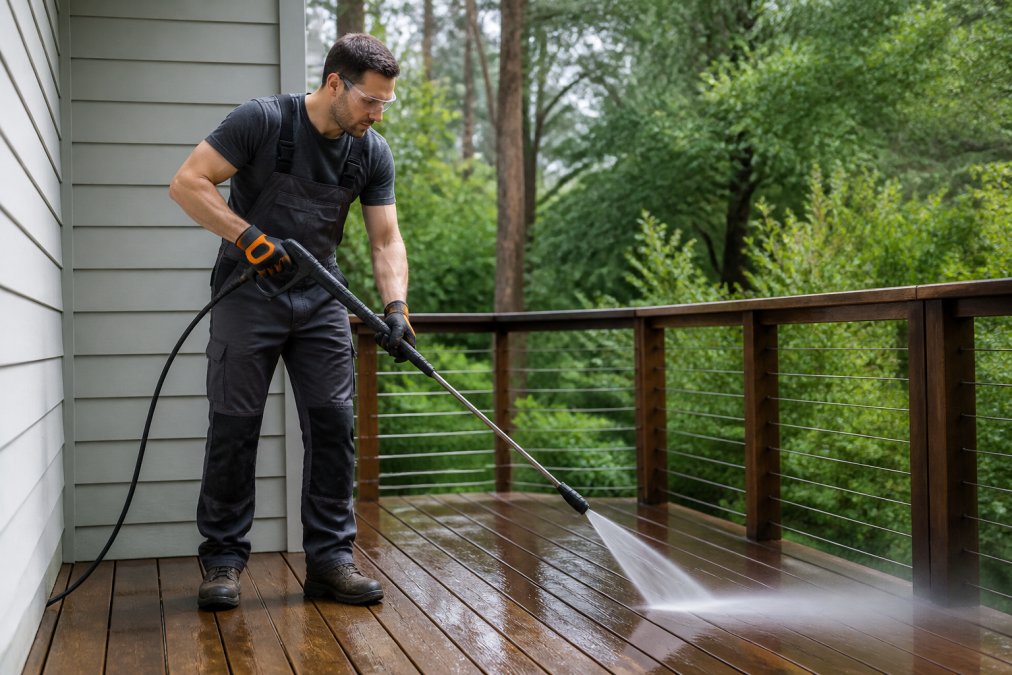
Test your pressure washer on a hidden area first. Confirm the PSI and nozzle produce the results you want without damaging the wood.
Applying Cleaning Solution and Detergent
Apply the cleaning solution before using pressure. This gives the chemical time to work.
Fill the detergent tank with a biodegradable timber cleaner. Attach the low-pressure nozzle (usually included for detergent application). Start at one corner and work systematically across the deck.
Apply the solution evenly, coating all surfaces. Don’t let it dry on the wood, keep the surface wet. For heavy mould, reapply after 5 minutes and let it sit for 10-15 minutes total.
The chemical breaks down mould and lifts dirt. You’ll see the deck darken as the solution penetrates. This is normal. The mould is dying.
Allow adequate contact time. Rushing this step means the mould survives and regrows. Patience now saves money on repeat cleaning later.
The Washing and Rinse Cycle
Once the solution has sat, switch to the pressure nozzle and rinse. Use a wide-fan tip at your predetermined safe PSI.
Start at the highest point of the deck and work downward. This prevents dirty water from flowing back onto cleaned areas. Maintain consistent distance and angle as you move.
Use smooth, overlapping strokes. Don’t linger in one spot, this concentrates pressure and risks gouging. Move steadily across each board.
Rinse thoroughly until the water runs clear.
Post-Wash Care and Drying
Drying is as important as washing. Wet timber is vulnerable to mould and rot.
Common Mistakes and How to Avoid Damage
The most common mistake is using pressure that’s too high. Homeowners assume more force equals cleaner results. In reality, excessive pressure splinters the wood and forces water into the grain where it causes rot.
Never pressure wash timber decks when the wood is frozen or frosty. Ice crystals in the wood expand when pressure forces water in, causing deep splitting that cannot be repaired. Wait for temperatures above 5°C and ensure at least 48 hours of dry weather ahead.
Environmental and Chemical Safety Considerations
The chemicals you use matter. They affect your family, your plants, and the local environment.
Frequently Asked Questions
Is it safe to pressure wash a wooden deck?
Yes, when done correctly with the right PSI and technique. Timber decks are vulnerable to splintering, furring, and water damage if pressure is too high. Using 1200-1500 PSI on hardwoods and 500-1000 PSI on softwoods, combined with proper nozzle selection and angle, protects wood fibres while removing dirt, mould, and stains. Always test on an inconspicuous area first, maintain proper distance from the surface, and allow adequate drying time before sealing or staining.
What pressure setting should be used for timber decking?
Pressure settings depend on wood type. Softwoods like pine and cedar need 500-1000 PSI to avoid damage; hardwoods like spotted gum or blackbutt can handle 1200-1500 PSI. Use a wide-fan tip (25-40 degrees) rather than a narrow jet, maintain 30-45 cm distance from the surface, and work along the wood grain to prevent splintering. Lower PSI with longer dwell time is safer than high pressure with brief contact.
How do I remove mould from timber decks without causing damage?
Soft washing is the safest method for mould removal. Apply a biodegradable detergent formulated for timber, let it dwell for 10-15 minutes to kill mould spores, then rinse gently with low-pressure water (under 1000 PSI). For stubborn mould, use a stiff brush with the cleaning solution before rinsing. Avoid high-pressure blasting, which can drive moisture deep into wood and cause future water damage. Ensure proper drainage and allow the deck to dry completely to prevent mould return.
What is the difference between soft washing and pressure washing for timber?
Soft washing uses low pressure (under 1000 PSI) combined with biodegradable cleaning solutions to safely remove mould, algae, and stains without damaging wood fibres or causing splintering. Pressure washing relies on higher PSI (1200-2000+) to blast away dirt and grime, which works well for concrete but risks surface damage on timber. For timber decks, soft washing is gentler on wood porosity and moisture content, while pressure washing suits hardwoods in excellent condition. Many professionals combine both methods: soft wash first, then light pressure rinse.
