
Table of Contents
- What Is the Best Way to Clean a Concrete Driveway?
- What You’ll Need: Tools and Cleaning Agents
- How to Remove Oil Stains from Concrete
- Choosing the Best Pressure Washer for Concrete Driveway Work
- Step-by-Step Guide to Pressure Washing Your Driveway
- How Often Should You Clean Your Driveway?
- Sealing and Preventing Future Stains
- Frequently Asked Questions
Last Updated: September 7, 2026
What Is the Best Way to Clean a Concrete Driveway?
The best way to clean a concrete driveway is to use a pressure washer with a fan tip, paired with a degreaser or concrete cleaner for stubborn stains. This two-stage approach removes embedded grime that water alone cannot lift, rather than simply blasting the surface. A proper clean concrete driveway also requires agitation, dwell time, and a thorough rinse to avoid leaving residue that attracts new dirt.
The method below reflects what actually works in the field. Most DIY attempts fail because they skip the chemical stage or use a narrow nozzle that etches grooves into the concrete. The complete process takes a few hours and protects the surface for years, especially when you finish with a sealer.
The key insight most guides miss is that pressure alone is rarely enough. Broom-finished concrete is porous, so oil, tyre marks, and organic growth sink below the surface. You need a cleaning agent to break that bond before the rinse cycle begins.
What You’ll Need: Tools and Cleaning Agents
Gather these items before you start, because stopping mid-job to buy supplies wastes time and lets cleaning agents dry on the surface.
Essential equipment:
- Pressure washer with a minimum 2000-2500 psi rating and a 25-40 degree fan tip
- Stiff-bristled brush (a deck brush with synthetic bristles works well)
- Degreaser designed for concrete, or a biodegradable detergent
- Safety goggles and protective gloves
- Broom or leaf blower for dry debris
- Concrete sealer and roller for the finishing stage
For the cleaning agent, many homeowners reach for a bleach solution or sodium hypochlorite to kill mildew and organic growth. These work, but they require careful handling and thorough rinsing so they do not damage nearby garden beds. A dedicated concrete cleaner is often safer and just as effective on general grime.
Never mix bleach-based cleaners with acidic products or degreasers (the CDC). The combination releases toxic chlorine gas. If you are unsure what is already on the surface, rinse thoroughly before applying anything new.
How to Remove Oil Stains from Concrete
Oil stains are the most common driveway eyesore, but the how to remove oil stains from concrete process differs from general cleaning because oil repels water. However, a truly professional approach recognises that not all stains respond to the same chemistry. Here is how to identify and treat the four most common driveway stain families.
Oil and Grease Stains
Start by covering the stain with an absorbent material like clay-based cat litter, cornflour, or sawdust. Leave it overnight to draw the oil out of the porous concrete, then sweep it away. For older, set-in stains, apply a commercial citrus-based or solvent-based degreaser, work it in with a stiff-bristled brush, and let it sit for 15-20 minutes of dwell time before pressure washing. Repeat the treatment if a ghost mark remains.
Rust Stains
Rust spots come from metal objects left on the surface, tools, furniture legs, or steel wheelbarrow tyres. These require an acid-based rust remover containing oxalic acid or phosphoric acid, not a degreaser. Apply it strictly according to the label directions, agitate gently with a nylon brush, and rinse immediately. Do not let acid-based products dry on the concrete, as they can etch the surface. For stubborn rust, a poultice of rust remover mixed with diatomaceous earth can be applied as a paste and left to draw the stain out overnight.
Organic Growth: Moss, Algae, and Mould
Dark, shaded driveways often develop green or black patches. These are living organisms, not embedded dirt, so they need a biocide. A sodium hypochlorite solution (household bleach diluted 1:3 with water) or a dedicated moss and algae killer works well (the EPA). Apply it on a cool, overcast day to prevent rapid evaporation, let it dwell for 15 minutes, then scrub lightly and rinse. For persistent black mould spots, a quaternary ammonium compound (often sold as a ’30-second cleaner’) is more effective and less damaging to nearby plants than bleach.
Efflorescence (White Chalky Deposits)
If you see a white, powdery residue on a newer driveway, that is efflorescence, mineral salts drawn to the surface by moisture evaporating from the concrete. It is not a stain in the traditional sense. A mild acid wash (1 part muriatic acid to 10 parts water) followed by a thorough rinse will remove it, but the underlying moisture issue must be resolved or it will return. In most cases, simply scrubbing with a stiff brush and plain water is enough for light deposits.
Always test any chemical on a small, inconspicuous area first. Concrete is porous and can react unpredictably to acids and bleaches, especially if it has been previously sealed. If you are unsure what is already on the surface, rinse thoroughly before applying anything new.
Tackle oil stains as soon as you notice them. Fresh spills clean up in minutes, while a stain that has cured for months may require multiple treatments or professional equipment. For rust and organic growth, the same rule applies, early intervention is always easier.
By identifying the stain type before you start, you avoid wasting time on the wrong chemical and reduce the risk of damaging the concrete surface.
Choosing the Best Pressure Washer for Concrete Driveway Work
The best pressure washer for concrete driveway cleaning balances power with control, because too much pressure damages the surface while too little merely wets it. The right choice depends less on brand loyalty and more on your driveway’s size, the severity of staining, and whether you plan to use the machine again.
Understanding the Numbers That Matter
Most residential machines are rated in psi (pounds per square inch) and flow rate in litres per minute (L/min). For concrete, the psi rating matters less than the flow rate (peer-reviewed research). A machine with 2000 psi but only 5 L/min will clean slower than one with 1800 psi and 8 L/min, because the higher flow flushes away dislodged dirt more effectively. Look for a machine with at least 7 L/min for concrete work.
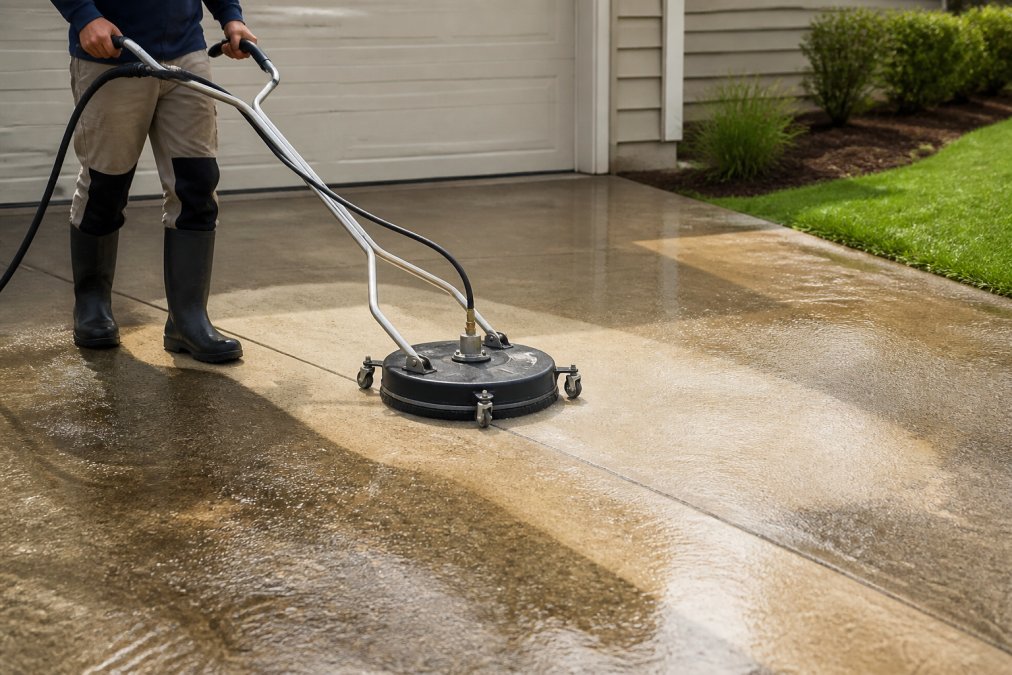
The nozzle angle is equally critical. A 15-degree tip blasts stubborn grime but can etch grooves if held too close or at a sharp angle. A 25-degree tip is the sweet spot for most concrete. A 40-degree fan tip is safer for rinsing but lacks the punch for set-in stains. A surface cleaner attachment, a spinning bar with two or more jets housed under a shroud, is the single best upgrade you can make. It maintains a consistent distance from the concrete, prevents tiger-striping, and cuts cleaning time by up to half.
Buy or Rent: A Practical Decision Guide
| Option | Best For | Considerations |
|---|---|---|
| Own electric unit (1800-2000 psi, 6-7 L/min) | Driveways under 50 square metres, occasional use | Cheaper long-term, quieter, lighter; lower flow rate means slower cleaning |
| Own petrol unit (2500-3000 psi, 8-10 L/min) | Driveways over 50 square metres, frequent cleaning, heavy stains | Higher power and flow; requires fuel, oil changes, and more maintenance |
| Rental machine (3000+ psi, 10+ L/min) | One-off deep clean of a large or heavily stained driveway | Cost-effective short-term (typically $80-$150 per day from hardware stores); includes a surface cleaner attachment; learning curve for first-time users |
A Simple Sizing Rule
Measure your driveway’s length and width to get the square metre area. If it is under 50 square metres and you only need a yearly clean, an electric unit with a surface cleaner attachment is sufficient. If it is larger, or if you have oil stains that have cured for months, a petrol unit or a rental machine with higher flow will save you hours of work. Rental machines from hardware stores often deliver the required power, but they come with a learning curve. If this is your first pressure washing job, start on a low-pressure setting and test an inconspicuous corner before working across the full driveway. The goal is to lift dirt, not to etch the concrete.
Whichever option you choose, always use a surface cleaner attachment for large flat areas. It is the difference between a professional-looking result and one with visible streaks. Handheld wands are best reserved for edges, corners, and tight spaces.
If you are unsure whether your driveway needs a machine you do not own, consider the cost of hiring a professional for a one-off deep clean versus the rental fee plus your time. For a single 80-square-metre driveway, consider the cost of hiring a professional for a one-off deep clean versus the rental fee plus your time.
Step-by-Step Guide to Pressure Washing Your Driveway
Follow this sequence for a clean concrete driveway that looks professionally maintained.
- Clear the surface. Remove cars, potted plants, and loose debris with a broom or leaf blower. Wet leaves and dirt hold moisture against the concrete and block the cleaning agents.
- Pre-treat stains. Apply degreaser to oil spots and a mildew cleaner to dark, shaded areas. Allow proper dwell time so the chemicals can break down the grime.
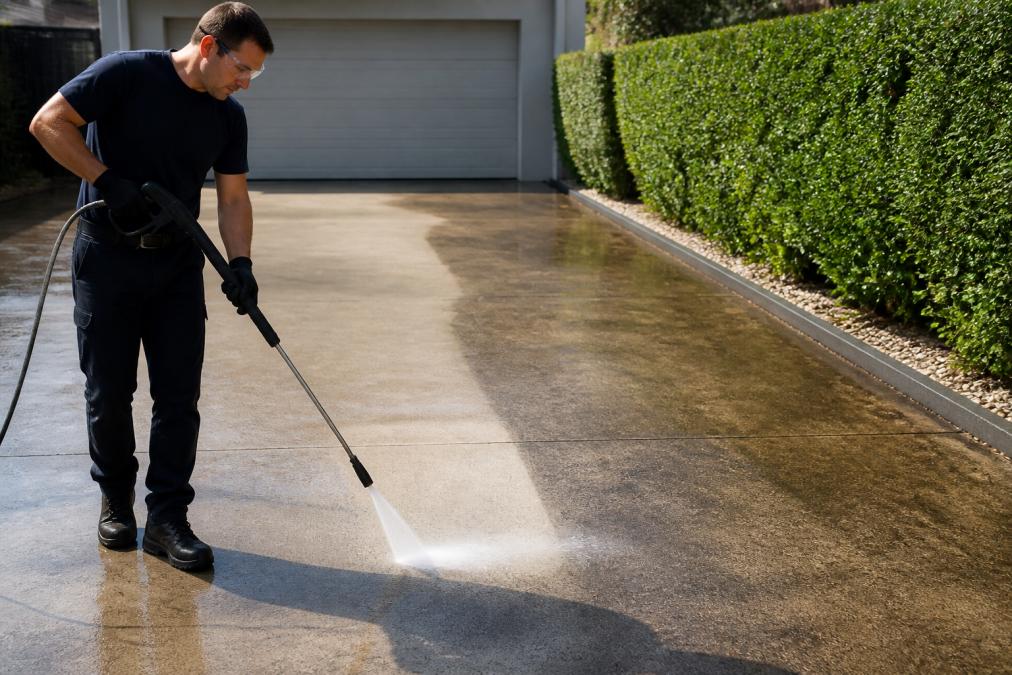
- Rinse with a fan tip. Working from the highest point of the driveway down, hold the wand at a slight angle and keep the nozzle about 30 centimetres from the surface. Overlapping passes prevent streaks.
- Agitate stubborn areas. For patches that resist the pressure washer, scrub with a stiff-bristled brush while the surface is still wet. The agitation lifts embedded dirt that water alone cannot.
- Final rinse. Switch to a wider spray pattern and rinse the entire area, working the runoff toward the street or garden where it can drain safely.
How Often Should You Clean Your Driveway?
Most driveways need a thorough clean once a year, though shaded properties or those under heavy tree cover may require two passes to keep organic growth at bay.
The question of how often should you clean your driveway depends on your environment. If you park cars on the surface daily, expect oil drips and tyre marks to accumulate faster. If your driveway sits in full sun, UV exposure helps kill mildew naturally, extending the time between cleans. Coastal properties face salt spray and may benefit from a mid-year rinse to prevent buildup.
A simple test: pour a bucket of water across the concrete. If it beads and runs off quickly, the surface is reasonably sealed and clean. If it soaks in rapidly, the pores are open and dirt is embedding deeper, which signals it is time for a clean and possibly a sealer.
Sealing and Preventing Future Stains
Sealing after cleaning is the step most homeowners skip, and it makes the difference between a driveway that stays clean for months and one that re-stains within weeks. A concrete sealer fills the microscopic pores that trap oil and organic growth, giving you a surface that rinses clean with a hose.
Apply the sealer only after the concrete has dried completely, which typically takes 24-48 hours depending on weather. Use a roller for even coverage and avoid walking on the surface until it cures. Most sealers need reapplication every 2-3 years, but the reduced cleaning effort makes it worthwhile.
The environmental impact of runoff matters here. When you clean a driveway, the water carries degreasers, oil, and chemical residue into storm drains. Choose biodegradable cleaning solutions where possible, and consider sweeping up absorbent materials rather than washing them into the gutter. This protects local waterways and keeps your cleaning routine responsible.
Pressure washing removes the dirt, but sealing prevents it from returning. A sealed driveway requires far less scrubbing and chemical use over its lifetime, which saves you time and reduces runoff.
For homeowners who lack the time, equipment, or confidence to tackle this job, professional help delivers the same result without the risk of surface damage. Sydney Pressure Washing Service uses both high-pressure and soft washing techniques with biodegradable cleaning solutions, ensuring effective removal of stains, mould, and grime while protecting your concrete and the surrounding environment. Our trade-licensed team handles everything from pre-treatment to final rinse, so you get a restored driveway without the guesswork.
Cleaning a concrete driveway properly comes down to using the right pressure, the right chemicals, and the patience to let them work. The full process, from pre-treatment to sealing, protects your surface and keeps it looking fresh for years. If you would rather leave it to the experts, Sydney Pressure Washing Service offers affordable, trade-licensed cleaning that removes even the toughest oil and organic stains. Get started with a free quote and see the difference a professionally cleaned driveway makes.
Frequently Asked Questions
What is the best thing to clean a concrete driveway with?
A pressure washer with a fan tip is the most effective tool for cleaning a concrete driveway. For the cleaning agent, use a concrete-specific detergent or a degreaser for oil spots. For general grime and mould, a bleach solution with sodium hypochlorite works well, but it must be rinsed thoroughly and kept away from gardens. Always start with the lowest pressure setting and test an inconspicuous area first to avoid etching the surface.
What should you avoid using when cleaning concrete?
Avoid using muriatic acid or other harsh acids, as they can permanently etch and discolour the concrete surface. Do not use a pressure washer with a narrow, zero-degree nozzle tip, as the concentrated stream can gouge the driveway. Also, avoid ammonia-based cleaners, which are ineffective on mould and can react badly with other chemicals. Always check that any detergent you use is safe for your surrounding plants and runoff.
How do I remove oil stains from a concrete driveway?
To remove oil stains, first cover the spot with an absorbent material like kitty litter or baking soda to draw out excess oil. Leave it for 24 hours, then sweep it up. Next, apply a commercial degreaser, scrub it into the stain with a stiff-bristled brush, and let it sit for the recommended dwell time. Finally, rinse the area with a pressure washer or high-pressure hose, directing the runoff away from storm drains.
How often should you clean your driveway?
For most homes, a thorough clean once a year is enough to prevent oil stains and organic growth from becoming a problem. If your driveway is shaded, has overhanging trees, or you live in a damp climate, you may need to clean it every six months to keep mould and mildew from taking hold. Regular sweeping and promptly treating new spills will keep your driveway looking newer for longer between full cleans.
