
Table of Contents
- Soft Washing vs Pressure Washing: What Actually Differs
- Comparison Table: Soft Washing vs Pressure Washing at a Glance
- Which Surfaces Need Soft Washing and Which Need High Pressure
- Why Does My Driveway Look Patchy After Pressure Washing
- Is Pressure Washing Safe for Brickwork
- Soft Wash Roof Cleaning Cost: What Affects the Price
- DIY vs Professional Cleaning: Where the ROI Breaks Down
- Recommended Maintenance Schedule for Exterior Surfaces
- Frequently Asked Questions
Last Updated: September 2, 2026
Soft Washing vs Pressure Washing: What Actually Differs
Most homeowners treat these two methods as interchangeable. They’re not, and using the wrong one on the wrong surface results in cracked roof tiles, splintered decking, or a driveway that looks worse than before you started. Sydney Pressure Washing Service provides both high-pressure power washing and gentle, biodegradable soft washing to address these surface-specific needs.
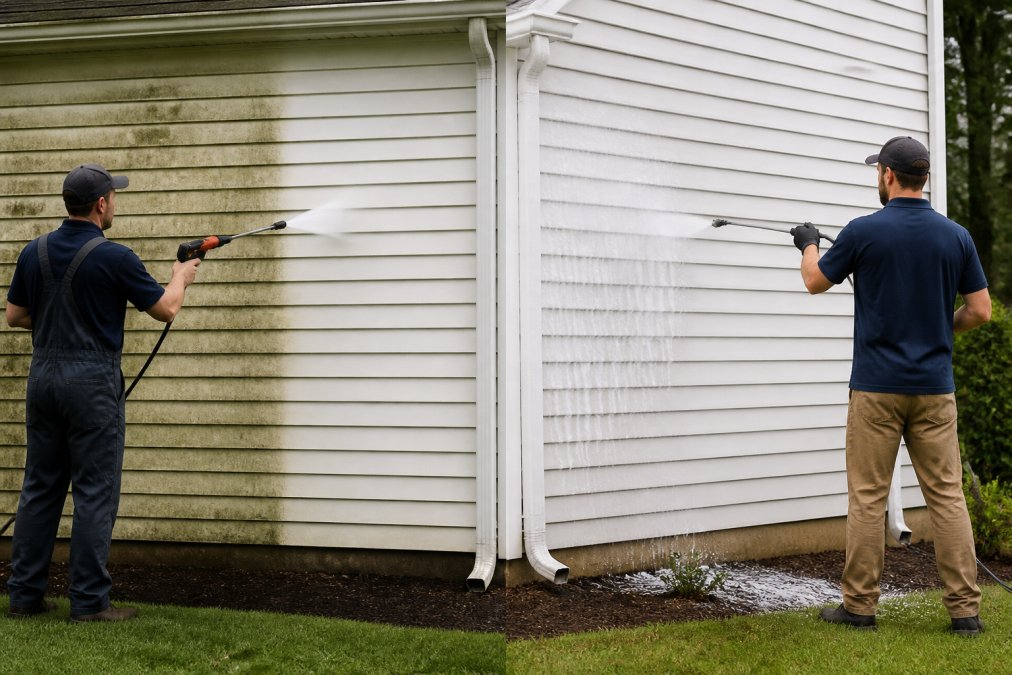
Soft washing is a low-pressure exterior cleaning method that relies on biodegradable chemical solutions, including surfactants and sodium hypochlorite, to kill and dissolve organic growth like algae, mould, and mildew at the source. Pressure is typically applied at or below 500 PSI.
Pressure washing is a high-pressure water cleaning method that uses mechanical force, typically between 1,500 and 4,000 PSI, to blast away dirt, stains, and debris from durable surfaces. One method treats the root cause of biological growth; the other removes surface contamination through sheer impact force.
How Pressure Washing Works (PSI, GPM, and Impact Force)
A pressure washer generates cleaning power through PSI (pounds per square inch, which measures impact force) and GPM (gallons per minute, which measures water volume). Professional-grade pumps typically operate between 2,000 and 4,000 PSI with 3.5 to 8 GPM.
Nozzle tips control spray angle and force concentration. A zero-degree red tip concentrates pressure into a single point for paint removal but destroys timber and render instantly. A 40-degree white tip disperses pressure across a wide fan for general cleaning. A surface cleaner attachment with spinning nozzles produces even results on concrete driveways without streaking.
How Soft Washing Works (Low Pressure, Surfactants, and Dwell Time)
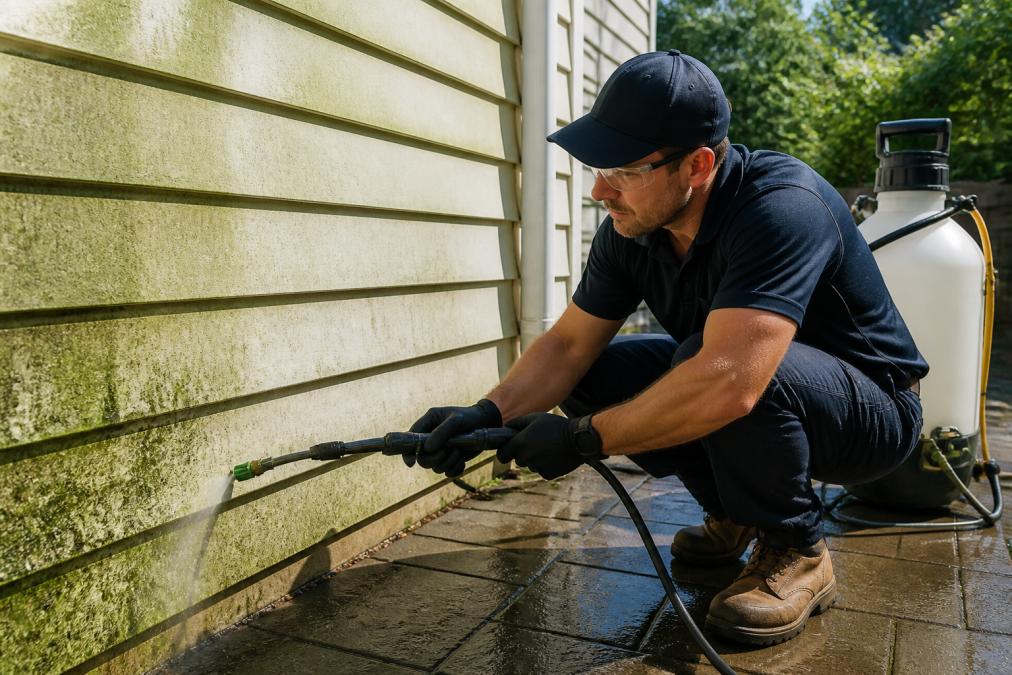
Soft washing applies chemical solution at low pressure via a chemical injector or dedicated pump. Sodium hypochlorite kills algae, mould, mildew, and lichen at the root level. Surfactants reduce surface tension, helping the solution penetrate porous materials like roof shingles and timber. Biodegradable neutralisers stop the chemical reaction after rinsing.
Dwell time is critical. The solution typically sits on the surface for 10 to 20 minutes before rinsing. The chemistry does the cleaning; water removes the residue. Because organic growth is killed rather than displaced, results last significantly longer.
Comparison Table: Soft Washing vs Pressure Washing at a Glance
| Factor | Soft Washing | Pressure Washing |
|---|---|---|
| Operating pressure | Below 500 PSI | 1,500 to 4,000 PSI |
| Water volume (GPM) | Low (1-2 GPM) | High (3.5-8 GPM) |
| Primary cleaning agent | Surfactants, sodium hypochlorite | Water impact force |
| Best surfaces | Roofs, timber, painted surfaces, vinyl | Concrete, masonry, pavers, brick |
| Organic growth removal | Kills at root level | Removes surface layer only |
| Risk to delicate surfaces | Very low | High if incorrect PSI/nozzle used |
| Typical dwell time | 10-20 minutes | None required |
| Result longevity | Longer (growth killed) | Shorter (growth regrows faster) |
| Chemical use | Always | Optional |
| DIY difficulty | Moderate-high (chemical handling) | Moderate |
Which Surfaces Need Soft Washing and Which Need High Pressure
The single biggest mistake in exterior cleaning is applying the wrong technique to the wrong substrate.
Roof Shingles and Tiles
Roof shingles and tiles should almost always be soft washed. High-pressure water strips the protective granule coating from asphalt shingles, accelerating weathering and voiding warranties. Concrete and terracotta tiles can crack or dislodge under sustained impact.
Black streaks on roofs are caused by Gloeocapsa magma cyanobacteria, lichen, and moss. Pressure washing removes visible growth but leaves the root system embedded. Within months, regrowth is visible. Soft washing kills the organism entirely.
According to the Tile Roofing Industry Alliance guidance on roof cleaning, high-pressure washing can damage roof tile surfaces and should be avoided.
Concrete Driveways and Masonry
Concrete driveways, masonry walls, and pavers are where pressure washing excels. These dense, non-porous surfaces withstand significant mechanical force. A surface cleaner attachment running at 2,500 to 3,500 PSI removes oil stains, dirt, tyre marks, and biological growth efficiently.
Older or damaged concrete requires care. Spalling or poorly cured concrete can be further damaged by excessive PSI. Lower pressure combined with pre-treatment chemical produces better results without accelerating degradation.
Masonry, particularly sandstone and soft limestone, is porous and erodes under high-pressure water. A hybrid approach, pre-treating with surfactant and rinsing at moderate pressure (under 1,500 PSI), is safest.
Timber Decks and Wood Siding
Timber is commonly damaged in DIY pressure washing jobs. High-pressure water directed across the grain raises fibres, creating a rough, splintered surface that absorbs moisture and stains unevenly.
For timber decks, a maximum of 600 to 800 PSI with a 40-degree nozzle tip, directed along the grain, is the upper limit. Many professionals prefer soft wash pre-treatment followed by gentle rinsing.
Wood siding, particularly older weatherboard, is especially vulnerable. High impact and water penetration force moisture behind cladding, promoting rot inside the wall cavity. Soft washing is the correct method for exterior wood siding in almost every case.
When cleaning a timber deck, test a small, inconspicuous area first at your intended PSI and check for grain raising before committing to the full surface. This takes five minutes and can save a full resanding job.
Why Does My Driveway Look Patchy After Pressure Washing
A patchy driveway after pressure washing usually stems from one of three causes.
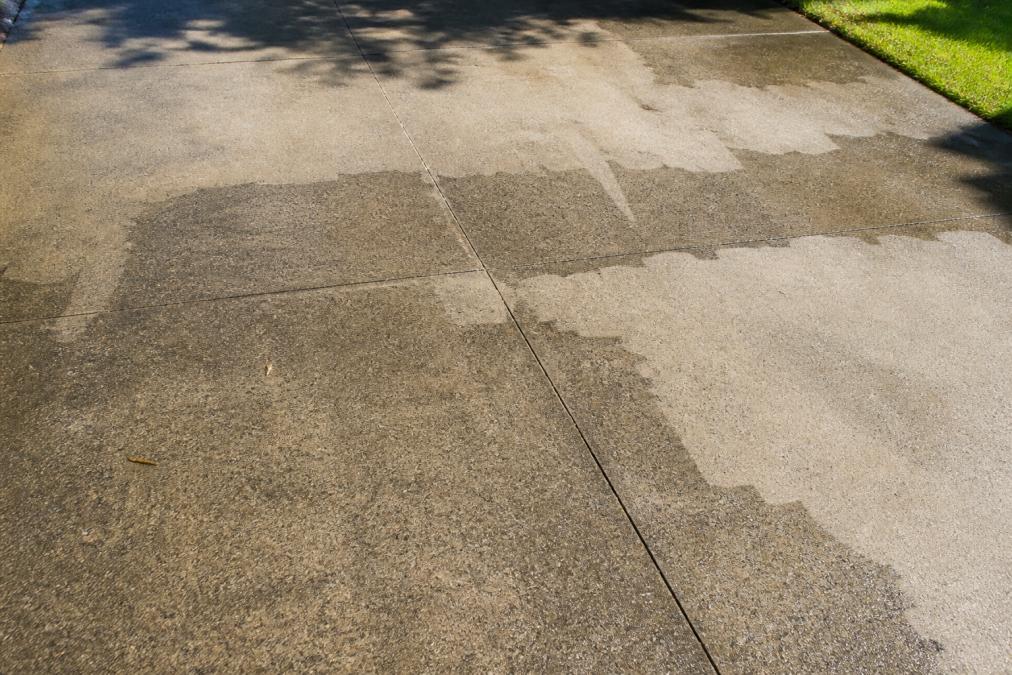
Inconsistent overlap occurs when a hand-held wand is used without a surface cleaner attachment, leaving different cleaning patterns on each pass. A surface cleaner eliminates this by maintaining constant, even pressure.
Pre-existing surface variation means concrete responds differently to pressure washing based on previous sealing, patching, or weathering exposure.
Insufficient dwell time on chemical pre-treatment prevents detergent or degreaser from breaking down embedded organic material or oil.
The fix is a two-stage approach: apply surfactant pre-treatment, allow proper dwell time, then clean with a surface cleaner attachment at consistent pressure.
Never use a zero-degree or 15-degree nozzle tip on a concrete driveway in a sweeping motion. The concentrated impact force etches the surface, leaving permanent white lines visible once concrete dries. These marks cannot be removed without grinding or resurfacing.
Is Pressure Washing Safe for Brickwork
Pressure washing is safe for brickwork, but mortar joints are the limiting factor. Brick itself is dense and tolerates moderate to high pressure. Mortar, particularly in older buildings, is softer and erodes under sustained high-pressure impact.
The Australian Institute of Architects technical resources on masonry maintenance guidance is that any cleaning method applied to heritage or older masonry should use minimum effective pressure to avoid irreversible damage to mortar joints and brick faces.
For standard residential brickwork, operate at 1,200 to 1,800 PSI with a 25-degree or 40-degree nozzle tip, keeping the wand at least 300mm from the surface. Pre-treating with surfactant reduces the pressure required.
For heritage brickwork, soft washing is strongly preferred. Mortar in pre-1960s construction is often lime-based rather than Portland cement-based, making it significantly more vulnerable to water erosion.
Soft Wash Roof Cleaning Cost: What Affects the Price
Soft wash roof cleaning cost varies based on roof size, pitch, and access difficulty. Steeply pitched roofs or those with limited access require additional safety equipment and time.
The severity of organic growth matters. Light algae requires standard chemical application. Heavy lichen or moss requires stronger solution concentration, longer dwell time, and sometimes a secondary visit.
Chemical costs form a real component of the job. Sodium hypochlorite, surfactants, and biodegradable neutralisers are consumables used in meaningful quantities.
Sydney Pressure Washing Service provides pricing information on its website and offers a free quote for residential and strata properties.
Price per year of result is a more useful comparison than price per job.
DIY vs Professional Cleaning: Where the ROI Breaks Down
Hiring a machine from a hire centre looks cost-effective but hire machines are typically lower-powered consumer-grade units lacking the GPM to match professional results on large areas. They rarely include surface cleaner attachments, chemical injectors, or the range of nozzle tips a professional kit carries.
For soft washing, retail products lack the concentrations professionals use. Diluted products extend dwell time and often don’t achieve full biological kill. Mould or algae regrows faster because the organism was suppressed rather than eliminated.
A professional who damages your roof, deck, or brickwork carries public liability insurance and is accountable. A homeowner who damages their own property has no recourse and may face repair bills exceeding the original cleaning cost.
According to Safe Work Australia guidance on working at heights, roof access work carries significant fall risk and requires appropriate safety equipment. For most homeowners, roof cleaning is not a safe DIY task.
Insurance, Liability, and Chemical Safety on Site
Professional exterior cleaning involves chemical handling that carries genuine risk. Sodium hypochlorite at working concentrations is a hazardous substance under the Safe Work Australia model code of practice for managing risks of hazardous chemicals. Improper handling causes skin and eye injury, and runoff without proper neutralisation can damage plants and breach local council environmental requirements.
A trade-licensed operator carries public liability insurance covering property damage and personal injury. They are responsible for chemical containment, neutralisation, and disposal in accordance with regulations.
Sydney Pressure Washing Service is trade-licensed and uses biodegradable cleaning solutions with proper neutralisers on every job, protecting garden beds and complying with local environmental requirements. For strata managers, this matters: liability for contractor damage on common property can fall back on the owners corporation if the contractor is uninsured or unlicensed.
Recommended Maintenance Schedule for Exterior Surfaces
Exterior cleaning is not a once-off event. Organic growth returns at rates depending on surface, local environment, and cleaning method.
| Surface | Recommended Cleaning Frequency | Preferred Method |
|---|---|---|
| Roof shingles / tiles | Every 2-4 years | Soft wash |
| Concrete driveway | Annually or bi-annually | Pressure wash with pre-treatment |
| Timber deck | Annually (pre-summer) | Low-pressure wash or soft wash |
| Brick exterior walls | Every 3-5 years | Low-pressure wash or soft wash |
| Wood siding / weatherboard | Every 2-3 years | Soft wash |
| Pavers and pathways | Annually | Pressure wash with surface cleaner |
| Strata common areas | Every 6-12 months | Pressure wash (surfaces dependent) |
Properties in high-humidity areas, with significant tree cover, or near the coast experience faster organic growth and may need more frequent attention. A maintenance schedule agreed with your cleaning provider produces better long-term results and lower per-job costs.
Choosing between soft washing vs pressure washing is straightforward once you understand what each method does to a surface. Sydney Pressure Washing Service handles both methods across residential, strata, and multi-unit properties, using biodegradable solutions, trade-licensed operators, and proper neutralisers on every job. Get a free quote and find out which approach is right for your surfaces.
Frequently Asked Questions
Is soft washing better than pressure washing for roof tiles?
Soft washing is generally the preferred choice for roof tiles. High-pressure cleaning can crack or dislodge tiles, strip protective granules from asphalt shingles, and force water under laps, causing internal moisture damage. Soft washing uses low-pressure delivery of sodium hypochlorite-based solutions that kill algae, mould, and lichen at the root.
Why does my driveway look patchy after pressure washing?
Patchy results on a concrete driveway usually come from one of three causes: inconsistent nozzle distance from the surface, varying PSI during the rinse cycle, or cleaning a section that had pre-existing staining sealed beneath the surface. Uneven passes with the surface cleaner attachment leave visible streaks. In some cases, the pressure has removed a top layer of sealant or efflorescence, exposing a different-coloured substrate underneath.
Can I convert my standard pressure washer into a soft wash system?
A standard pressure washer can be adapted for soft washing using a downstream chemical injector that introduces surfactants and sodium hypochlorite into the water flow after the pump. This protects the pump seals from chemical damage. However, the PSI still needs to be controlled with the correct low-pressure nozzle tips, typically a 40-degree or soap nozzle. Without proper training and dilution ratios, DIY chemical application risks damaging surfaces, harming plants, and creating liability if runoff affects neighbouring properties.
Do you need to rinse the roof after a professional soft wash treatment?
Yes, a rinse cycle is standard practice after soft washing a roof. Once the cleaning solution has completed its dwell time, usually 15 to 30 minutes depending on the level of organic growth, a low-pressure rinse removes dead algae, mould residue, and surfactant film. Skipping the rinse leaves chemical residue that can discolour tiles and harm nearby plants. Reputable operators also apply a neutraliser after rinsing to ensure no active sodium hypochlorite remains on the substrate or in stormwater runoff.
Is pressure washing safe for brickwork?
Pressure washing is safe for brickwork only at controlled PSI levels, generally below 1,500 PSI, and with wide-angle nozzle tips. Older or soft-face bricks are particularly vulnerable: excessive impact force erodes the mortar joints and can cause spalling on the brick face itself. Newly repointed brickwork should not be pressure washed for at least 28 days to allow the mortar to cure fully. For heavily stained or heritage brickwork, soft washing with an appropriate masonry-safe cleaning solution is the lower-risk method.
Is soft washing worth the extra cost compared to pressure washing?
For delicate surfaces like roofs, wood siding, and painted render, soft washing is often chosen to avoid surface damage. High-pressure cleaning removes visible growth but leaves spores in the substrate; soft washing’s sodium hypochlorite solution kills the organism completely, slowing regrowth. For hard, durable surfaces like concrete driveways and brick pathways, pressure washing at the correct PSI is often the more cost-effective choice. The right method depends on the surface.
