
Table of Contents
- Strata Exterior Maintenance: What Owners and Committees Need to Know
- Common Property vs Lot Property Maintenance: Who Pays for What
- Your Strata Maintenance Checklist for Exterior Surfaces
- Strata Cleaning Inspection Preparation: A Step-by-Step Approach
- Budgeting and Sinking Fund Planning for Long-Term Asset Management
- Sustainable and Eco-Friendly Exterior Maintenance Practices
- Vendor Management and Vetting for Strata Exterior Works
- Using Technology to Track Strata Exterior Maintenance
- Frequently Asked Questions
Last Updated: September 30, 2026
Strata Exterior Maintenance: What Owners and Committees Need to Know
Strata property exterior maintenance tips start with one uncomfortable truth: the building envelope is the most expensive asset your scheme will ever manage, and it is the one most owners ignore until water is already inside. This guide from Sydney Pressure Washing Service sets out who pays for what, what to inspect and when, and how to fund the work without a special levy ambush.
Common Property vs Lot Property Maintenance: Who Pays for What
Common property is everything in a strata scheme that is not contained within a lot, and the owners corporation is responsible for its repair and maintenance. Get this boundary wrong and you will spend months arguing over a bill that was never yours.
Typical common property items
- External walls, render and cladding
- Roofs, gutters, downpipes and drainage
- Balconies, balustrades and railings
- Driveways, pathways and car park surfaces
- Shared HVAC systems and mechanical plant
Lot owner responsibilities
Owners typically maintain everything inside their own unit: internal walls, fixtures, carpet, and the surfaces within their lot boundary. The dividing line is usually the inner face of the external wall, though scheme by-laws and the registered plan override general assumptions.
A common mistake is treating a balcony as “private” because only one owner uses it. In most schemes the structure and waterproofing of a balcony remain common property, so a failed membrane is an owners corporation cost, not the lot owner’s.
Your Strata Maintenance Checklist for Exterior Surfaces
A strata maintenance checklist works best when it is organised by surface rather than by calendar month, because each material fails at a different rate and needs a different inspection cycle. The table below is a starting schedule; adjust it to your building’s age, coastal exposure and construction type.
| Surface | What to Inspect | Warning Signs | Frequency |
|---|---|---|---|
| Facade, render and cladding | Cracks, damp patches, mould, paint condition, sealant joints | Hairline cracks wider than a credit card, efflorescence (white salt staining), drummy render when tapped | Every 6 months |
| Gutters and downpipes | Debris load, fall, joint integrity, downpipe discharge points | Water staining on fascia, overflow during moderate rain, rust at seams | Twice yearly, plus after major storms |
| Roofing and tiles | Cracked or slipped tiles, rust on metal sheeting, flashing and ridge capping | Granule loss in gutters, daylight visible through sheeting, lifted fixings | Annually, plus after hail |
| Balconies and balustrades | Membrane condition, drainage outlets, fixing tightness, corrosion at base plates | Ponding water, rust weeping from fixings, movement when pushed | Annually, with a physical load check |
| Windows and door frames | Sealant, glazing, frame rot or corrosion, hardware operation | Draughts, water tracking inside, sticking windows | Annually |
| External stairs and pathways | Trip hazards, spalling concrete, handrail stability | Loose pavers, cracked nosings, rusted handrail anchors | Every 6 months |
Walls, facades and the building envelope
Check for dampness, mould growth, peeling paint and cracked render every six months. Small hairline cracks let water in, and repeated wetting drives concrete cancer in reinforced sections. Tap render with a screwdriver handle, a hollow sound means the render has debonded from the substrate and will need removal before recoating. Pay particular attention to horizontal surfaces where water sits: parapet capping, window sills and the tops of retaining walls.
Gutters, downpipes and drainage
Blocked gutters and downpipes are the single most common cause of internal water damage in low-rise blocks. Clear them before storm season and again mid-year. Check that downpipes discharge into stormwater, not onto pathways or garden beds where they undermine footings. On buildings with box gutters, an annual internal inspection with a camera is worth the cost, by the time overflow is visible inside, the ceiling lining is already damaged.
Roofing, balconies and balustrades
Look for rust spots, lifted tiles and loose fixings. Balustrades need a physical check, not just a visual one, since safety standards for barriers are non-negotiable. A common pattern is for balcony waterproofing membranes to reach the end of their service life at around the same time as the balustrade fixings corrode, plan both together so the membrane is not disturbed twice.
Windows, doors and external stairs
Sealant around window and door frames typically lasts five to ten years before it shrinks and cracks. Re-sealing is inexpensive and prevents water tracking into wall cavities. On external stairs, check handrail anchors and step nosings, which are the two most common trip-and-fall liabilities on strata common property.
Schedule the walk-through after rain, not before. Dampness and active leaks are far easier to spot, and you will catch drainage problems a dry inspection misses.
Do not treat a visual inspection as a substitute for a specialist report on balustrades, roof anchors or structural elements. Visual checks catch cosmetic decline; they do not confirm load capacity or compliance with current barrier standards.
Strata Cleaning Inspection Preparation: A Step-by-Step Approach
Preparing for a strata cleaning inspection means walking the site with a contractor before any work begins, documenting every surface, and agreeing on method and access. A written scope beats a verbal quote every time.
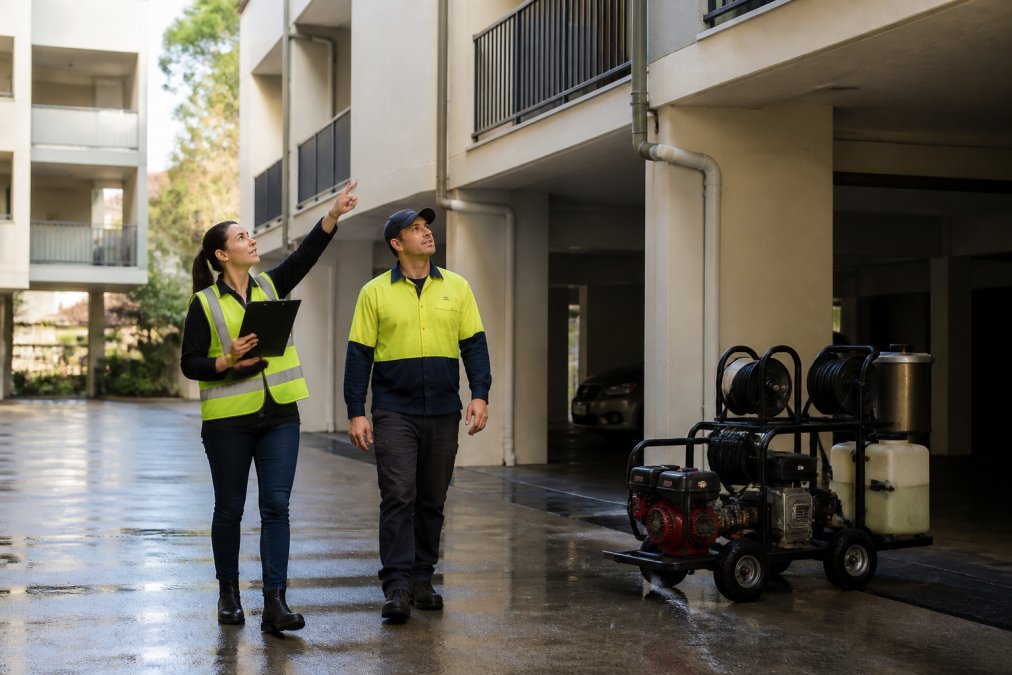
- Book the joint walk-through with your committee and the cleaning contractor.
- Photograph each surface and note its condition, including rust spots and mould.
- Confirm which surfaces need soft washing versus high pressure.
- Check water access, power points and parking for equipment.
- Agree on a start date, duration and a wet-weather contingency.
- Record the agreed scope in writing before work starts.
Budgeting and Sinking Fund Planning for Long-Term Asset Management
A capital works fund exists precisely so exterior maintenance never lands as a surprise special levy. Most schemes underfund it because committees plan for visible repairs and forget the slow, predictable decay of the building envelope.
Long-term asset management is not about spending less. It is about spending predictably, so owners are never hit with a five-figure levy in a single quarter.
Sustainable and Eco-Friendly Exterior Maintenance Practices
Eco-friendly exterior maintenance comes down to three things: the right method, the right solution, and protecting what surrounds the building. High pressure on the wrong surface does more damage than dirt ever will.
- Use biodegradable solutions with neutralisers where runoff reaches gardens
- Match pressure to the surface, never the other way around
- Protect landscaping and neighbouring property before work begins
- Capture and manage runoff on driveways and pathways
Vendor Management and Vetting for Strata Exterior Works
Contractor management starts with verification, not price. A cheap quote from an uninsured operator becomes the committee’s liability the moment someone is injured on a roof.
| What to Check | Why It Matters |
|---|---|
| Public liability insurance | Covers damage or injury on site |
| Trade licensing | Confirms competence and compliance |
| Safe work method statement | Documents risk controls |
| References from similar buildings | Proves real-world results |
Using Technology to Track Strata Exterior Maintenance
Most strata guides stop at the checklist. The gap none of them fill is how committees actually capture, store and act on maintenance data over the ten to fifteen years a building envelope takes to cycle through its major repairs. Technology in maintenance is less about gadgets and more about records, but a few tools genuinely change what a committee can see and prove.
Drone roof and facade inspections
A licensed drone operator can capture high-resolution imagery of roofs, parapets and upper facades without scaffolding, rope access or working-at-height permits. For a multi-storey building, this is often the difference between inspecting the roof annually and inspecting it only when a leak appears. The output is a dated image set you can compare year on year, slipped tiles, new rust runs and blocked gutters become visible as changes rather than as a single snapshot.
Thermal imaging for hidden moisture
Infrared cameras detect temperature differences that reveal trapped moisture behind render, under membranes and around window openings, problems that look invisible to the naked eye until they surface as internal damage. A thermal scan before and after a major rain event is a practical way to map where water is actually entering, rather than guessing from the inside.
IoT leak and moisture sensors
Battery-powered leak sensors placed in plant rooms, basement car parks and riser cupboards can send an alert to the strata manager’s phone the moment water is detected. They are inexpensive relative to the cost of a single water-damage insurance claim, and they are particularly useful in buildings with below-ground areas that are rarely walked.
A shared maintenance register
Whatever tools you use, the record matters more than the tool. A simple shared register, a spreadsheet or a strata management platform module, should capture, for each asset: last inspection date, inspector, condition rating, defects noted, action taken and next due date. This turns a vague “it looks fine” into an auditable history that proves due diligence, supports insurance claims, and survives committee turnover.
| Tool | What It Reveals | Practical Trade-off |
|---|---|---|
| Drone inspection | Roof and high facade condition | Needs a licensed operator and airspace checks |
| Thermal imaging | Hidden moisture and insulation gaps | Best performed in specific temperature conditions |
| IoT leak sensors | Active water ingress in plant and basement areas | Requires Wi-Fi or mobile coverage and battery upkeep |
| Maintenance register | Full asset history and due dates | Only as good as the discipline of updating it |
Committees managing multiple buildings, older schemes with recurring defects, or any building where committee members rotate frequently and institutional memory is lost at each AGM.
The point of technology here is not novelty. It is defensibility, a dated, comparable record that shows the owners corporation has actively monitored and maintained common property, which is exactly what insurers, buyers and regulators expect to see.
Frequently Asked Questions
What is the most overlooked exterior maintenance task in a strata building?
Gutter and downpipe clearing is the task most often skipped until water damage appears. Blocked gutters cause overflow into eaves, dampness in walls, and peeling paint on facades. Adding a twice-yearly gutter check to your strata maintenance checklist, particularly before storm season, prevents costly repairs to the building envelope and keeps surface cycles draining correctly.
Is the owners corporation responsible for gutter cleaning and roof repairs?
In most strata schemes, gutters, downpipes and the roof are common property, so the owners corporation is responsible for their upkeep. The strata committee should schedule preventative maintenance rather than wait for emergency repairs. Confirm the exact boundaries in your scheme’s by-laws and plan, because some townhouse-style schemes treat certain roof sections differently.
Are balcony tiles and grout considered common property for maintenance?
It depends on the scheme. In many buildings, the balcony structure and waterproofing membrane are common property while the tiles may be lot property. Grout and tile repairs on balconies often fall to the owners corporation where waterproofing is involved. Check your strata plan and by-laws, and ask your strata manager to clarify before arranging strata cleaning inspection preparation.
How often should a strata property undergo professional exterior cleaning?
Most buildings benefit from a full exterior clean every 12 months, with high-traffic areas like driveways and entryways cleaned more often. Buildings near main roads, coastal areas or with heavy tree cover may need six-monthly servicing. Regular cleaning removes mould growth, rust spots and grime before they affect structural integrity or property aesthetics.
What is the difference between preventative maintenance and emergency repairs in strata?
Preventative maintenance is scheduled work, such as annual facade inspections, gutter clearing and soft washing, that keeps common property in good condition. Emergency repairs address sudden failures like a burst pipe or storm damage. A sinking fund should cover both planned works and unexpected events, which is why long-term asset management planning matters for every strata committee.
How can strata committees effectively manage exterior maintenance budgets?
Start with a 10-year capital works plan that lists every common property asset and its expected service life. Get at least two written quotes for scheduled works, review insurance and licensing for each contractor, and set aside a percentage of levies each quarter for the capital works fund. Reviewing the plan annually keeps the budget realistic as costs and building conditions change.
Exterior maintenance is where most strata schemes quietly lose money: deferred cleaning becomes failed waterproofing, and failed waterproofing becomes a special levy. Sydney Pressure Washing Service helps committees stay ahead of that curve with trade-licensed teams, soft washing for delicate surfaces, and biodegradable solutions that protect both the building and the garden beds around it. Get a free quote and put a documented exterior maintenance plan in place before the next storm season.
